Quzhou Aoyin Metal Materials Co.,Ltd


Extrusion vs Die Casting vs Stamping: Battery Box Guide
Blog
Extrusion vs Die Casting vs Stamping: Battery Box Guide
Release time:
2026-09-13
Source


A 5,000-piece run of battery enclosures is where the choice gets expensive. Three processes make aluminum battery boxes — extrusion, high-pressure die casting, and sheet-metal stamping — and quotes on the same drawing differ by 40 to 60%. The spread comes from how the metal flows, where the seams live, and what the dies cost before the first part ships. This guide covers what each process does well, where each one fails, and the checklist that keeps a buyer's RFQ honest.
Table of Contents
The three processes at a glance
| Process | Geometry sweet spot | Tooling cost (1) | Min. run for cost recovery | Wall-thickness limit | Seam count |
|---|---|---|---|---|---|
| Aluminum extrusion | Long, prismatic, multi-cavity | ~30-80k RMB per die | 1,000+ pieces | ≥1.2 mm | One weld seam at the joint (FSW) |
| High-pressure die casting | Complex 3D, thin bosses, integrated features | 500k-2M RMB per die (large parts higher) | 5,000+ pieces | 2.5-4.0 mm | None ("one-shot") |
| Sheet-metal stamping | Simple flat or shallow-draw lids/covers | 50-200k RMB per die set | 3,000-5,000 pieces | 0.6-1.0 mm | Hem joints / spot welds |
(1) Tooling cost for the battery-box class of part; varies by part size, alloy, and feature count. Sources: 永锢科技 2026 industry reference; 灵通资讯 2026-05; AOYIN production experience.
The numbers already hint at the trade: extrusion is the cheap-to-start process that scales down to prototype runs; die casting has the most expensive die on the menu but the lowest per-part cost above a threshold; stamping wins covers and shallow lids where geometry is simple.
Extrusion: long, prismatic, multi-cavity
Heat an aluminum billet to about 450-500 °C, push it through a hardened steel die, and the die's cross-section is the shape that comes out. For a battery box, that cross-section is almost always hollow with internal ribs — the multi-cavity profile that gives the box 40%+ more bending stiffness per kilo than a single-chamber shape of the same weight (永锢科技 2026).
The production step that decides cost is the die. A multi-cavity porthole die for a battery-box profile runs in the 30-80k RMB range, versus the 500k-2M RMB bracket for a large high-pressure die-cast tool — roughly 10-25× more. That gap is why extrusion remains the default for low- to mid-volume programs and any new model where the sales forecast is uncertain.
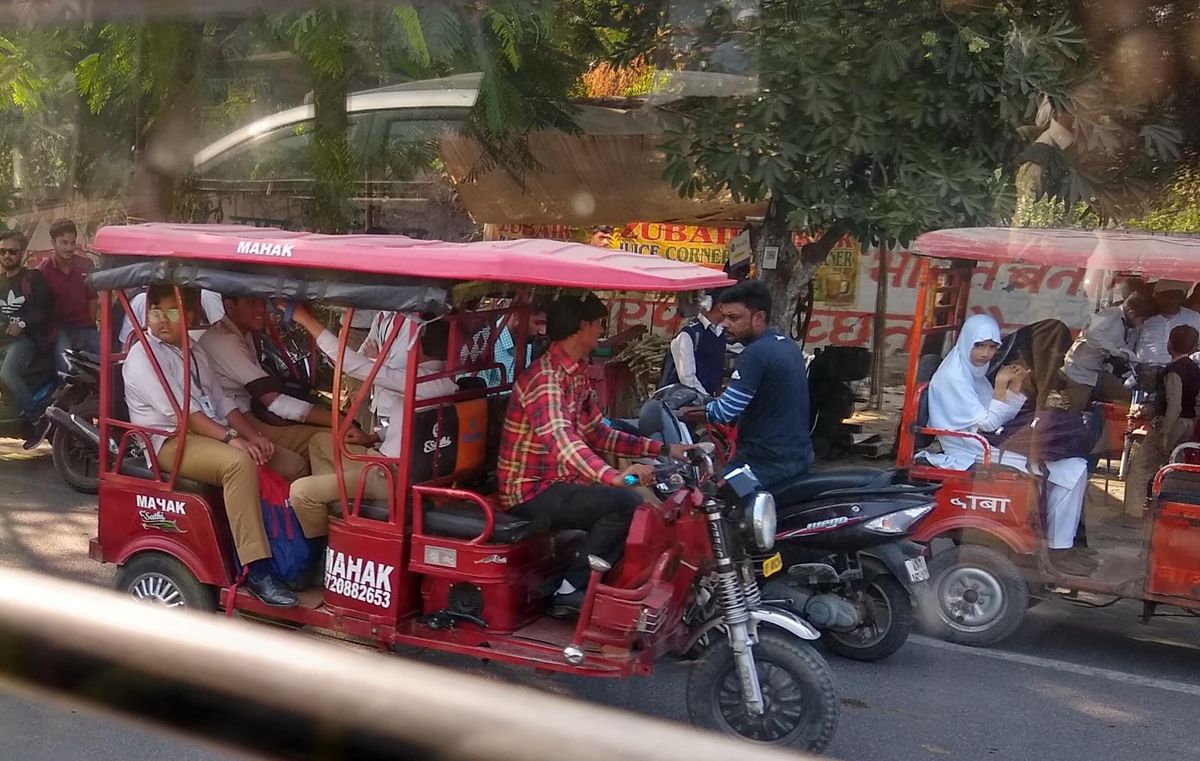
For an e-rickshaw 48V/100Ah battery box (~40-45 kg finished weight), the typical extrusion route is:
Extrude two C-channel profiles + two face sheets
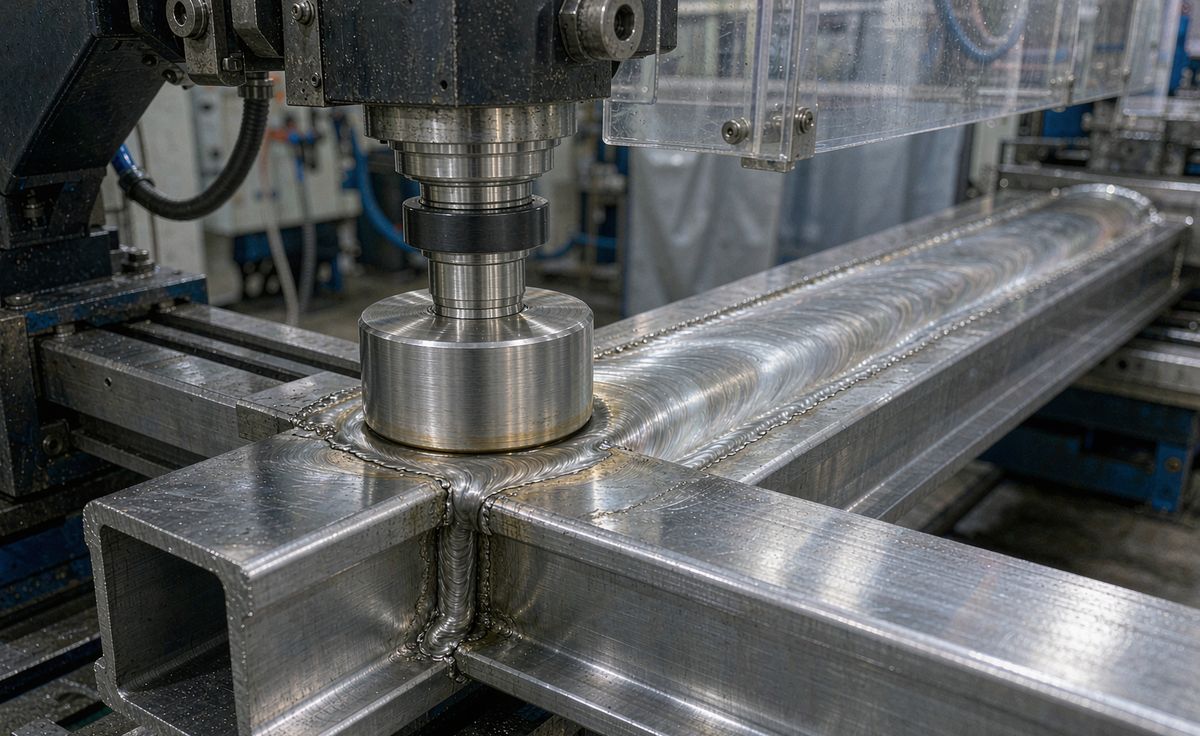
Friction-stir-weld (FSW) the four joints
CNC-machine sealing faces and mounting bosses
Anodize (AA10-AA15, 5-20 µm)
Die casting: complex 3D, no seams, expensive die
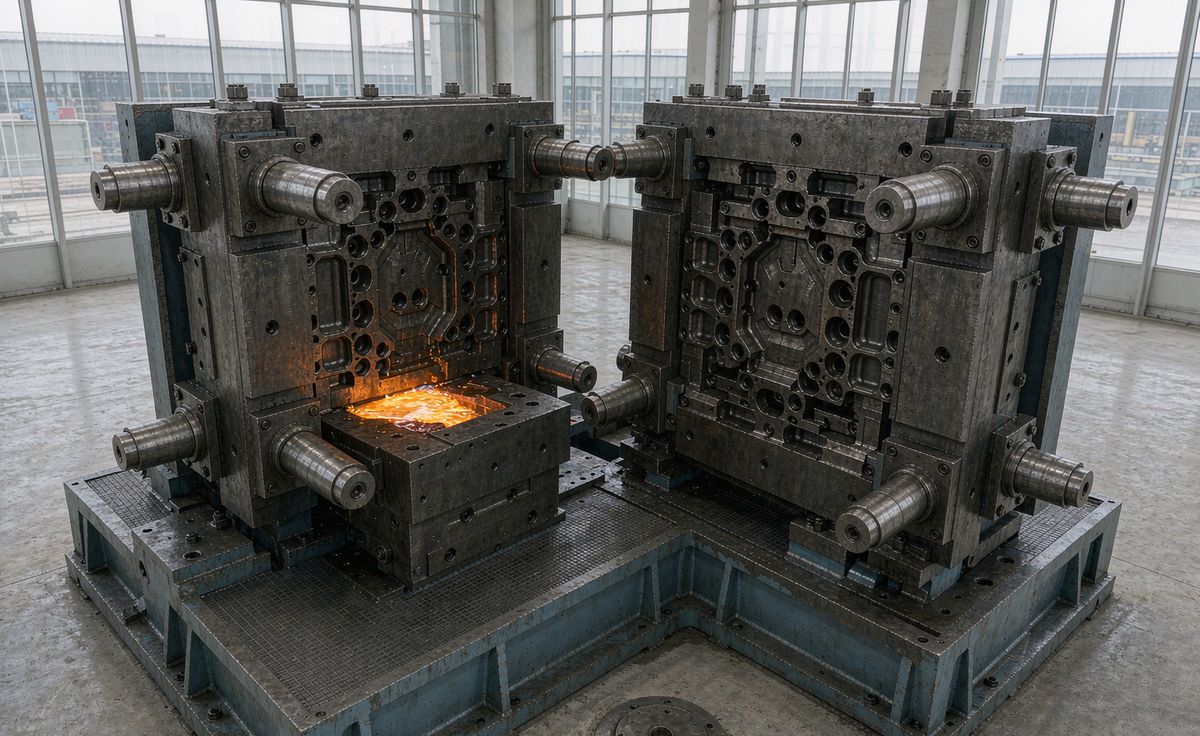
Die casting pushes molten aluminum into a steel die under high pressure. The geometry that pays for the die is anything 3D with undercuts, bosses in multiple axes, or large thin walls — exactly the shapes a battery-box lid with integrated cooling channels and connector bosses wants. Tesla's Model Y body structure is the landmark — the front and rear underbody combined went from ~171 stamped parts (the prior Model 3 architecture) down to 2 large castings (one front, one rear, each made on a 6,000-9,000-ton Gigapress), with 1,600 spot welds eliminated and roughly a 20% mass reduction on the rear underbody itself. BYD's CTB 2.0 (9,000-ton press) reports "100+ kg saved" versus the prior steel underbody, with 74 stamped parts collapsed into one cast part.
Two numbers come with the process and matter at quote time:
Porosity. Standard die casting leaves porosity in the 1-3% range; vacuum-assisted die casting brings it down to ~0.3% porosity and pushes tensile strength to about 280 MPa with 30% higher impact toughness than non-vacuum castings (灵通资讯 2026-05).
Die cost. A 12,000-ton-class die-casting island runs into the hundreds of millions of RMB, and the dies themselves are large, water-cooled, and not cheap. The first 5,000 pieces of any program typically don't recover the die investment — only after that does die casting's per-part cost beat extrusion's (嘉峪检测 2026).
The corollary for an e-rickshaw program: if annual volume is under a few thousand units, die casting is almost never the right answer, no matter how clean the part looks.
Stamping: simple covers and lids at unit cost
Stamping takes sheet aluminum (typically 3003 or 6061 in 0.6-1.5 mm) and forms it in a press. The wins are geometric: flat covers, shallow-draw lids, end caps. The losses are also geometric: every new feature is another die station, and deep draws beyond about 1.5× the blank width thin the wall badly.
For battery-box programs, stamping shows up in three places: end caps on extruded bodies, top covers on shallow prismatic packs, and the connector-plate assemblies that bolt to the main enclosure. A whole battery box made by stamping alone is rare — the geometry of a sealed, IP-rated enclosure is too deep.
The mixed approach the industry actually runs
Pure-process battery boxes are rarer than the marketing suggests. The production reality is hybrid: Audi e-tron battery housing (嘉峪检测 2026, ref [26]) uses 6xxx extruded profiles with die-cast corners and FSW welding, credited with "outstanding static strength, fatigue performance, corrosion resistance, and crash performance." Feifan ER6 uses a large die-cast underbody with extruded ribs.
For an e-rickshaw or 3-wheeler battery enclosure, the hybrid almost always means extruded body + FSW + CNC + anodize. The volume doesn't justify a dedicated die-cast tool, the geometry is prismatic, and the welding investment stays low.
The seam in the middle: FSW and what it does not fix
Friction-stir welding (FSW) is the standard joint for extruded battery enclosures — it stirs the aluminum into a solid-state bond without melting, and a properly welded seam retains 80-90% of base-metal strength (灵通资讯 2026; 嘉峪检测 2026).
The seam's weakness is also its nature: FSW is solid-state, so it cannot penetrate deep sections like a fusion weld can. FSW joints are typically limited to the surface 2-3 mm of the material in heavy structural sections — and longitudinal load-bearing regions in a tray can sit below the stirred zone, leaving an unwelded root that fatigue cracks will find. This is the trade-off that lets die-cast trays claim a sealing advantage: no seam, no seam-cracking failure mode.
For an extruded battery box, the practical answer is good FSW process control: rotation 1,400-2,400 rpm, traverse 700-1,300 mm/min, with 100% seam-strength test on first article. A pin-offset failure that drops seam strength below 73% of base metal is the documented failure mode (《电动汽车电池包搅拌摩擦焊缝泄漏故障分析》, 金属加工 2025-10), and it is the kind of failure that audit-welcome shops prevent by qualifying welds, not just running them.
Decision tree: which process for your geometry
| Your situation | Recommended process | Why |
|---|---|---|
| Prismatic box, ≥1.5 m long, ≥500 units/year, ≥2 variants per year | Extrusion + FSW | Die cost amortizes; geometry fits; variants are die swaps, not new tools |
| Complex 3D lid with cooling channels, ≥5,000 units/year, single part | High-pressure die casting | Die pays back above 5k; no seam; integrated features |
| Shallow cover, lid, end cap, ≥3,000 units/year | Stamping | Lowest per-part cost; integrates with extruded body |
| Mixed (e-tron / ER6 pattern) | Die-cast corners + extruded rails, FSW + bolt | Best of both; common in production mid-2020s |
| Prototype,<500 units | Extrusion + CNC | Avoid die-cast die investment until volume is real |
The honest counterpoint: when extrusion is wrong
Extrusion is not always right. Three cases where the wrong call is to extrude:
3D geometry extrusion can't reach. A box with deep bosses in three axes or a contoured cooling-channel lid is a die-cast part. Extrusion produces constant cross-sections only.
Sub-1,000-unit annual volume with a complex shape. Even if extrusion is "possible," the cost-per-part math works out only because the die amortizes — at very low volumes, the die cost per part dominates.
High-severity crash load through a weld. If the design load path puts a longitudinal bending stress on a welded joint, FSW's 80-90% seam strength means a die-cast design carries more margin for the same mass.
In those cases, pushing extrusion is the wrong engineering decision. Specifying die casting — or hybrid — is the honest answer, even from a shop that extrudes for a living.
RFQ checklist for buyers
Send these and the quote is honest; omit any and the quote is guesswork:
Part L × W × H and max wall thickness, with the 3D model (.step or .iges), not just a PDF
Annual volume and target unit price (or the program that fixes the volume)
IP rating requirement (write IP67 or IPx7 by AIS 156, not "waterproof")
Sealing method: FSW only, FSW + O-ring, or fully continuous weld
Alloy and temper (6063-T5 / 6063-T6 / 6061-T6), with mill-test certificate per lot
For FSW: ask for the supplier's seam-strength qualification method — the answer with a number is the right supplier
FAQ
Which process is cheapest for an e-rickshaw battery box?
For typical e-rickshaw 48V / 100Ah volumes (1,000-10,000 units/year, prismatic geometry), extrusion + FSW + CNC + anodize is cheapest. Die casting's die investment (500k-2M RMB) does not pay back below ~5,000 units per year.
What is FSW's seam strength as a percentage of base metal?
A properly qualified FSW seam holds 80-90% of base-metal strength. Documented failure modes (pin offset, cold joints) drop this to 73-80%, which is why suppliers should publish their seam-qualification data, not just a "we do FSW" line.
Why did Tesla switch to die-cast underbodies?
Three reasons that compound: 171 → 2 parts (front and rear underbody combined) eliminates 1,600+ spot welds and roughly 300 assembly robots; the rear underbody alone drops from ~70 stamped pieces to 1 casting, with a roughly 20% mass reduction on the rear floor; cycle time on the rear-floor subassembly drops from roughly two hours to ~90 seconds per car. At Tesla's volumes (and now BYD, Volvo, Toyota, Hyundai, NIO), a 6,000-9,000-ton Gigapress pays back in months, not years.
Can a die-cast battery box really have "no seams"?
Yes, in the structural sense — the cast part is monolithic, so there are no FSW or fusion-welded seams. There are still O-ring sealing joints between cast components and end caps; "no seams" refers to the structural body, not the gasket interfaces.
Can you supply extruded, die-cast, or stamped boxes depending on the part?
Yes — we run extrusion (presses up to 5,000 t), our own CNC workshop, and anodizing as one integrated production network with every stage open to customer audit. For hybrid or die-cast parts, we work with qualified sub-suppliers and stay the engineering owner of the box design — send your drawing or pack dimensions to info@aymetals.com or WhatsApp +86 133 0570 9557; we reply with a design review and a quote, usually within one working day.
Related: How Aluminum Extrusion Works for Battery Boxes · 6063 vs 6061 vs 6082: Which Alloy for Battery Boxes · Aluminum vs Steel vs Plastic Battery Enclosures · Extruded Aluminum Profiles (Product)
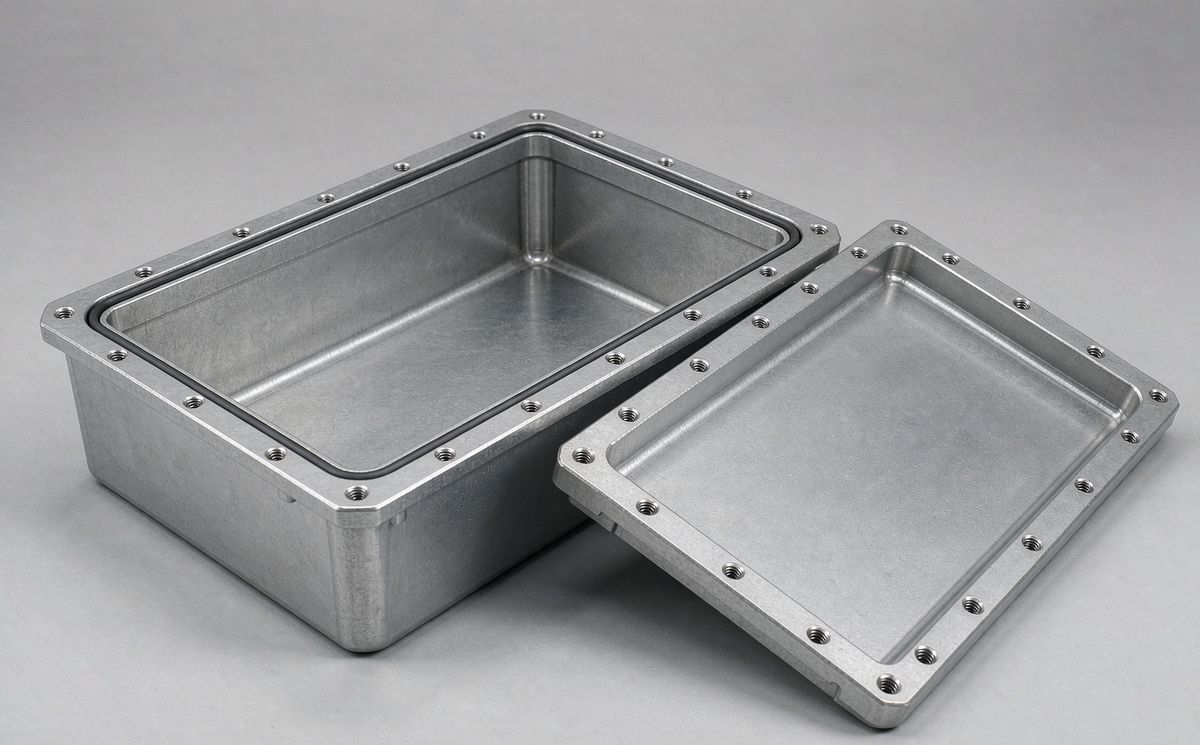
Photos: AOYIN production-render illustrations. Not client-specific product photos.
RELATED NEWS
Need Aluminum Battery Enclosures?
From extrusion to CNC machining and anodizing, AOYIN delivers end-to-end manufacturing for EV battery housings.
Email:
Add:No 339-1 shangye village Gouxi Township Kecheng district Quzhou City, zhejiang province,China
Add:No 339-1 shangye village Gouxi Township Kecheng district Quzhou City, zhejiang province,China
-
-
-
-

WhatsApp