Quzhou Aoyin Metal Materials Co.,Ltd


IP54 vs IP65 vs IP67 for E-Rickshaw Battery Boxes
Testing & tolerances
Release time:
2026-09-02
Source


In April 2022, three Indian EV makers recalled a combined 6,656 electric two-wheelers after a string of battery fires. Within four months the road transport ministry had rewritten AIS 156, and by March 31, 2023 every lithium battery sold in an L-category EV in India — that includes every e-rickshaw and e-cart on Indian roads — had to pass IPx7 immersion testing before it could be homologated.
If you spec or supply battery boxes, that single change made "IP rating" a real procurement question instead of a marketing line. Suppliers now advertise IP54, IP65, IP67, sometimes IP68, often without telling you which tests actually passed. This article is the matching of those codes to what your box actually has to do.
Table of Contents
How to read an IP code
An IP code is two digits with separate jobs under IEC 60529: the first covers solids and dust, the second covers water.
"IP" stands for Ingress Protection. The system is defined by IEC 60529:2013, adopted in China as GB/T 4208-2017 and in India as IS/IEC 60529. The two digits each have one job:
First digit (0–6): solids, mostly dust. 6 = dust-tight.
Second digit (0–9K): water. 4 = splashing from any direction, 5 = jets, 6 = powerful jets, 7 = temporary immersion, 8 = continuous immersion, 9K = high-temperature, high-pressure jets.
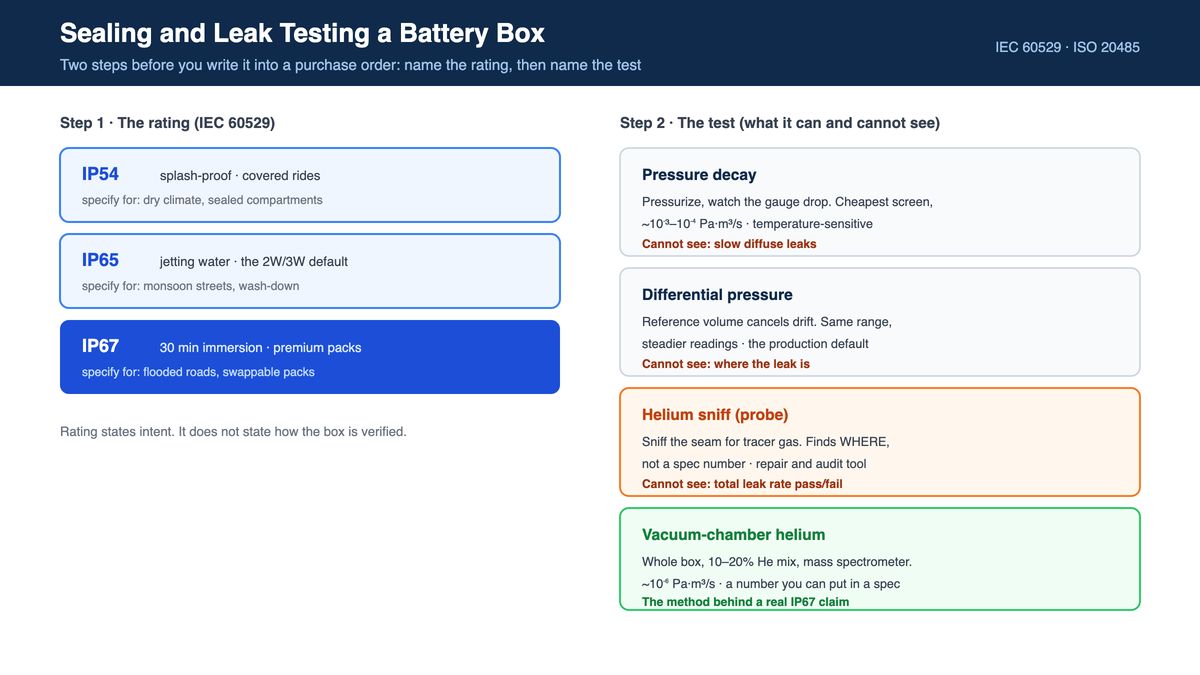
A code of IP67 therefore says: completely dust-tight AND survives being 1 m underwater for 30 minutes. A code of IP54 says: dust-protected (not sealed) AND splashed from any direction.
Three things worth knowing up front:
Each digit is a separate test. A box can pass IP6X (dust) and IPX7 (water), which is what you see on most battery packs. The marketing shorthand "IP67" is the same thing expressed together.
The standard test sequence is water first, then dust. Sealing surfaces that pass wet testing can be degraded by later dust exposure. If a supplier's dust testing happens on a freshly machined sample, ask when the dust pass was run.
Neither digit is the same as a crush or vibration test. IP ratings say nothing about the box's mechanical survival on Indian roads.
IP54: splash-tested, usually vented, fine for lead-acid
IP54 means water splashing from any direction for at least 10 minutes, and dust-protected rather than dust-tight — which is exactly what a vented lead-acid tray needs.
IP54 is the most common rating for a lead-acid battery tray on a passenger e-rickshaw. The water side means: water splashing against the enclosure from any direction for at least 10 minutes, with no harmful ingress. The dust side means: dust protected, not dust-tight — some ingress is allowed as long as it does not interfere with operation.
Why this is acceptable for lead-acid: the batteries themselves vent hydrogen during charge. A sealed IP67 box would trap that gas. IP54 lets the enclosure breathe through gasketed vents or labyrinth paths, while still shedding the rain that comes in sideways during a monsoon.
| Parameter | IP54 test condition |
|---|---|
| Dust | Limited ingress permitted (category 4) |
| Water | Splashing from any direction, 10 min |
| Typical use | Vented lead-acid e-rickshaw tray, indoor controllers |
| Typical sealing | Gasketed seams + breather valve |
In an LFP retrofit where you swap the lead-acid for lithium, the IP54 tray becomes the wrong box for the new chemistry. A lithium pack does not vent and a 5 mm leak will soak the cells. We see this mistake in about a third of retrofit RFQs: the customer keeps the existing tray because "it held the lead-acid fine," then fails AIS 156 immersion testing on the rebuilt pack.
IP65: jet-tested, dust-tight, the in-between rating
IP65 is fully dust-tight but only jet-tested: a 6.3 mm nozzle at 12.5 L/min, from any direction, for at least 3 minutes.
IP65 takes the dust up a level (fully dust-tight) but only requires water-jet protection — water projected by a 6.3 mm nozzle at 12.5 L/min, against the enclosure from any direction for at least 3 minutes.
| Parameter | IP65 test condition |
|---|---|
| Dust | Dust-tight (category 6) |
| Water | 6.3 mm nozzle, 12.5 L/min, 3 min from any direction |
| Typical use | Outdoor electrical cabinets, e-scooter battery enclosures in arid regions |
| Typical sealing | Continuous gasket, machined or molded flanges |
IP65 is the "in-between" rating and the most over-marketed one. It does not cover temporary immersion. A box rated IP65 that falls into a flooded Lucknow street will leak; the test does not include submersion.
For most e-rickshaw applications, IP65 is either overkill (lead-acid does not need it) or not enough (lithium packs need immersion protection). We recommend IP65 only for inland e-scooter packs where monsoon immersion risk is genuinely low.
IP67: 1 m immersion, what AIS 156 actually asks for
IP67 puts the lowest point of the enclosure 1,000 mm under water for 30 minutes, and AIS 156 Phase 2 has required it on lithium packs since March 2023.
IP67 is the test that AIS 156 Phase 2 (in force since March 31, 2023) requires for lithium traction packs in every L-category vehicle in India. The water side is the headline number: the lowest point of the enclosure is placed 1,000 mm below the surface of water for 30 minutes, with no harmful ingress.
| Parameter | IP67 test condition |
|---|---|
| Dust | Dust-tight (category 6) |
| Water | 1 m immersion, 30 min |
| Typical use | Lithium e-rickshaw and e-cart packs, AIS 156 mandatory |
| Typical sealing | CNC-machined sealing faces ±0.05 mm, silicone or EPDM O-ring (the white-rubber ring on the lid), pressure vent |
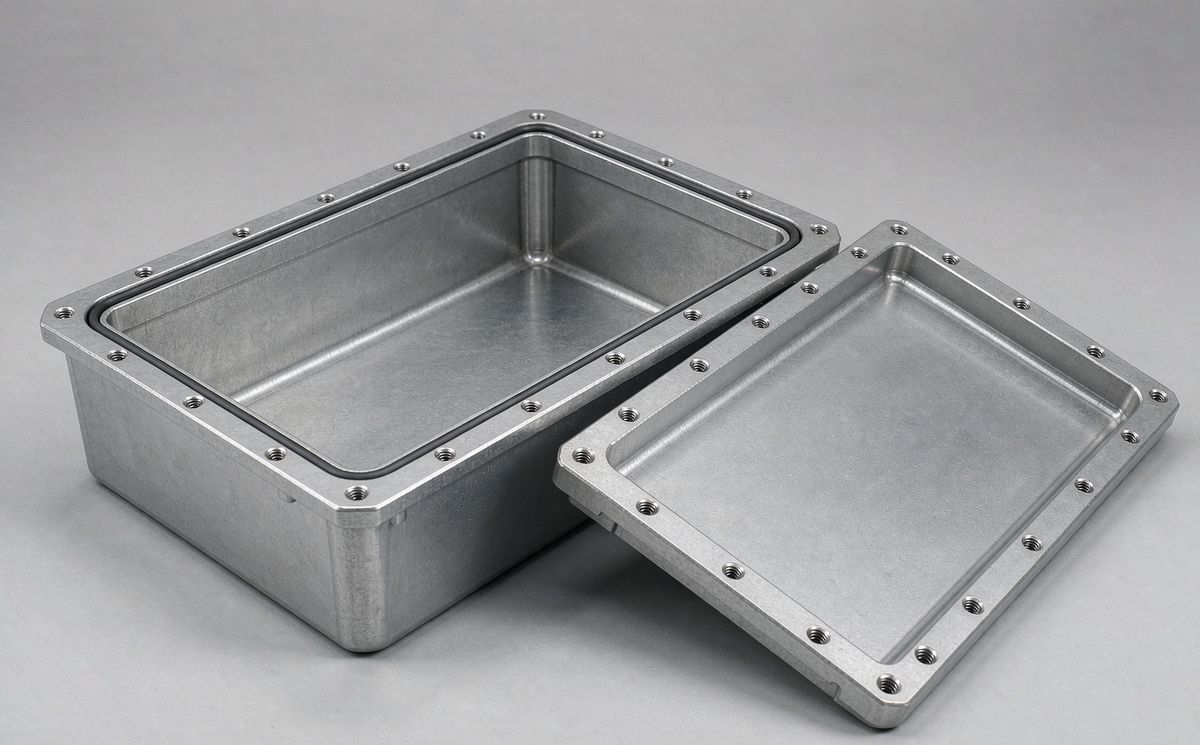
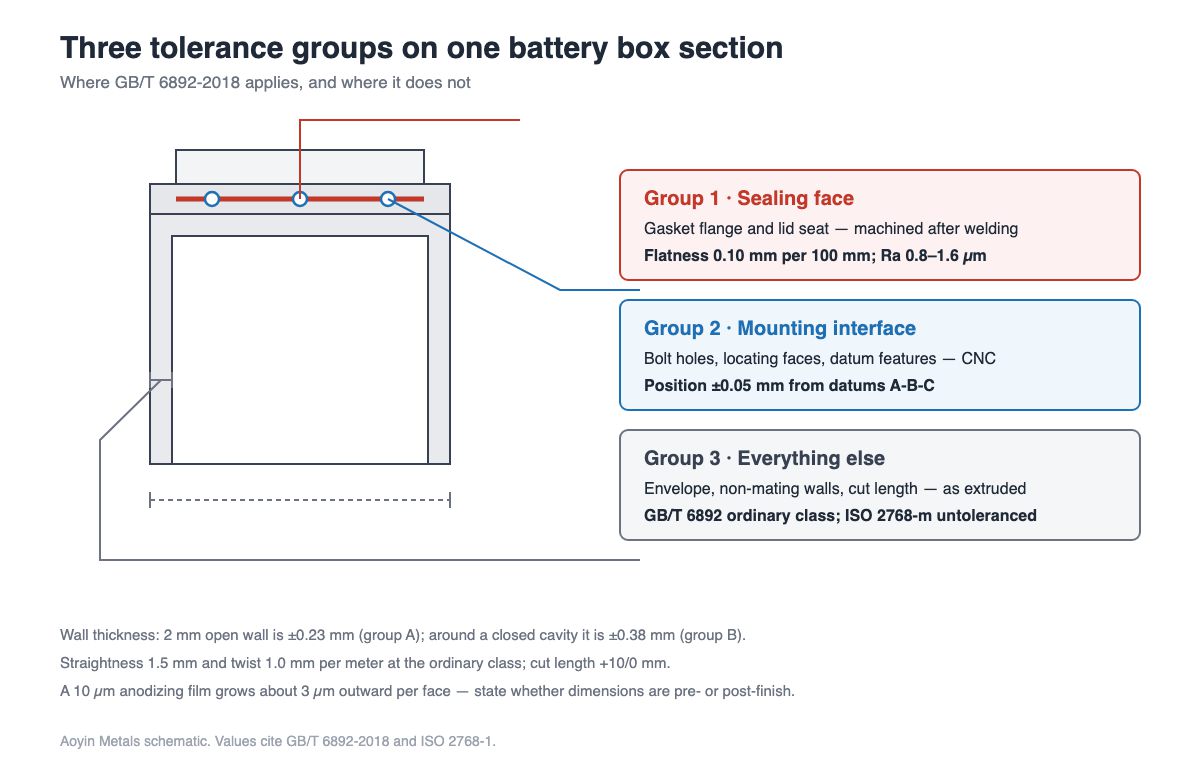
The machined sealing face and gasket groove in the photo are what turn an extruded aluminum section into an IP67 enclosure. EN 755-9 tolerances of ±0.3–0.5 mm on as-extruded surfaces are too loose for a reliable seal; the groove and mating face must be CNC-machined to ±0.05 mm and then fitted with a silicone or EPDM O-ring. An IP67 battery box without that machined face and O-ring is not IP67.
A note on the test surface. The IEC 60529 IPx7 test uses clean water at room temperature. It does not capture a real monsoon — road water is dirty, salty in coastal districts, and may carry fuel residue that degrades rubber faster than the test simulates. The AIS 156 amendments around thermal propagation and immersion also assume the enclosure has pressure-vent provision; a fully sealed aluminum box with no vent path will bulge or vent through the gasket in a thermal event.
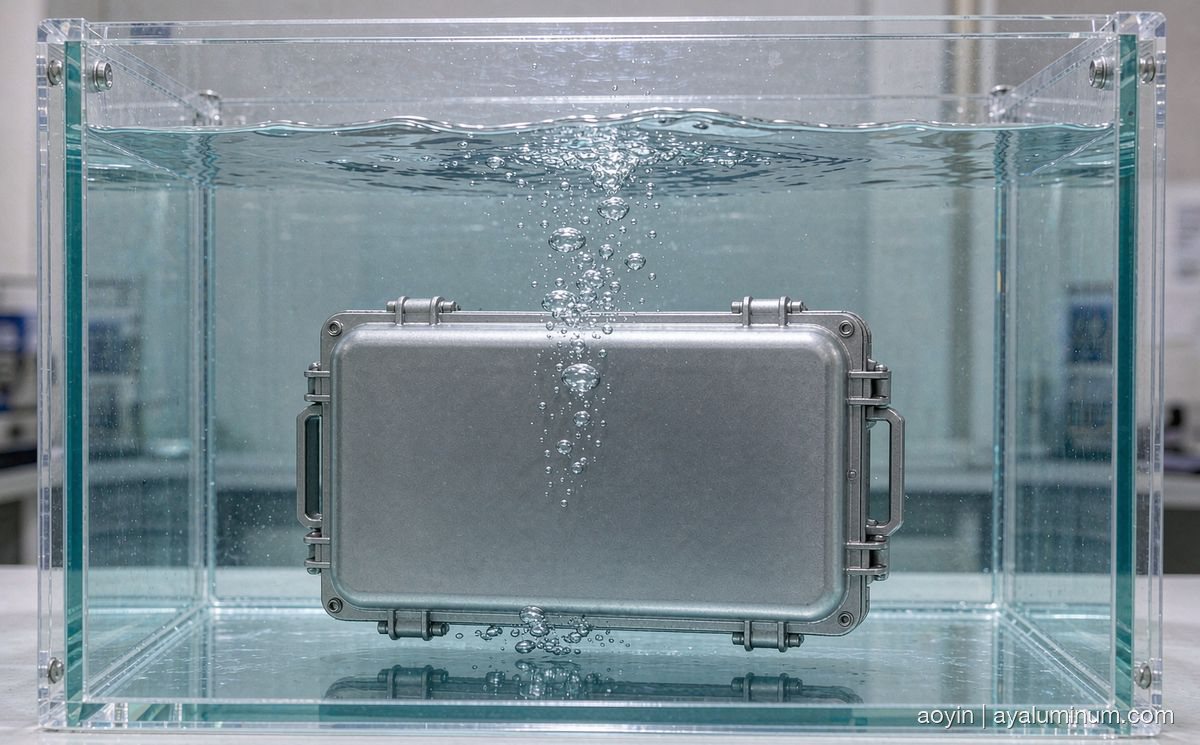
The tank in the photo simulates the IPx7 test that AIS 156 Phase 2 mandates: 1 m of water for 30 minutes with no harmful ingress. Clean lab water is only the baseline — real monsoon runoff carries grit and salts that degrade rubber faster than the standard simulates, which is why gasket material selection and salt-spray rating matter beyond the immersion certificate.
The order of these two numbers is part of the standard. "IP67" and "IP76" are different tests. The first code is the most-cited because it happens to be the one AIS 156 mandates — if you see a supplier quoting anything else, ask which test clause they passed.
Things suppliers don't volunteer (the honest version)
As-extruded tolerances do not hold an IP67 seal on their own — EN 755-9 allows ±0.3 to ±0.5 mm, and no gasket compresses that range.
Two things we flag on every quote that the marketing copy tends to leave out.
1. As-extruded tolerances do not hold an IP67 seal by themselves. EN 755-9 sets aluminum extrusion dimensional tolerance at ±0.3 to ±0.5 mm for sections under 100 mm. A gasket cannot compress that range; the gasket groove and the mating face must be CNC-machined to a tighter tolerance, typically ±0.05 mm. If a supplier quotes "IP67 aluminum battery box" without a line item for machined sealing faces, the rating was not earned — it was labeled.
2. IP rating is a sample test, not a per-unit test. Third-party labs test a handful of completed enclosures per production lot. The rating describes the design, the sample that passed it, and the lot discipline — not every individual box that leaves the line. A real supplier can show you a current IP test report per lot and the CNC machining records that make the seal face repeatable. One that cannot probably has not tested.
A third thing worth saying, since honest reviews are more useful than flattering ones. For a sealed lithium pack on a freight e-cart that crosses flooded roads every monsoon, IP67 alone is not enough. You also want a pressure vent (because a sealed pack will build gas pressure from any cell that vents), a sacrificial breather drain (so standing water that does enter can exit), and a gasket material rated for the thermal cycle the box will actually see. AIS 156 covers the IPx7 immersion; the rest of that stack is your engineering judgment, not a certificate.
The spec-sheet line
Four lines turn "IP67" into something you can reject a shipment against: the rating, the test standard, the machined tolerance on sealing faces, and the gasket hardness.
Write these into your next PO:
Required rating: IP67 for lithium packs under AIS 156; IP54 explicitly for vented lead-acid
Test standard cited: IEC 60529:2013 / GB/T 4208-2017; lot test report per shipment
Sealing faces: CNC-machined ±0.05 mm; gasket groove called out on the drawing
Gasket: material, Shore A hardness (typically 50–70), and working temperature range specified
Pressure vent: machined boss or relief valve, marked on the drawing
Salt-spray: 96 h minimum (or per your market requirement)
Sample immersion test on a finished assembly — not just on the box
If a quote comes back with the rating but without the machined-face line item and the per-lot test report, you are buying a labeled box, not a tested one.
We extrude, CNC-machine, and anodize aluminum battery boxes for two- and three-wheeler OEMs through our integrated production network, with mill test certificates, and tolerance reports available. Every stage of production — from billet to finished box — is open to your audit. Send your pack dimensions, cell layout, and target IP rating to WhatsApp +86 133 0570 9557 or info@aymetals.com, and we usually reply with a design review and numbers within one working day.
FAQ
What is the difference between IP54, IP65, and IP67?IP54 = dust-protected + splashed from any direction. IP65 = dust-tight + 6.3 mm water jet from any direction (3 min). IP67 = dust-tight + 1 m immersion for 30 minutes. Each digit is tested separately under IEC 60529.
Does AIS 156 require IP67 for e-rickshaw battery boxes?For lithium packs, yes — AIS 156 Phase 2 (in force since March 31, 2023) calls up IPx7 (1 m, 30 min) for L-category vehicles, which includes e-rickshaws and e-carts. Lead-acid trays remain vented, typically IP54.
Can an IP54 battery box be used for lithium packs?Not if you intend to homologate under AIS 156. An IP54 box does not pass the IPx7 immersion test and will leak when a lithium pack is submerged. Lead-acid platforms that retrofit to lithium need a new enclosure.
What tolerance is required on the sealing face?±0.05 mm on CNC-machined end-cap faces and gasket grooves. As-extruded faces (EN 755-9 allows ±0.3–0.5 mm on small sections) will not hold an IP67 seal on their own.
Does IP67 mean the box can be permanently underwater?No. IP67 covers 30 minutes at 1 m. Permanent or deeper submersion requires IPx8, which IEC 60529 specifies by agreement between supplier and customer (typically 1.5–3 m for the duration agreed).
Is IP65 good enough for Indian monsoon conditions?For inland arid regions, often yes. For a lithium pack that crosses flooded streets every monsoon, IP65 is below AIS 156 minimum — go to IP67.
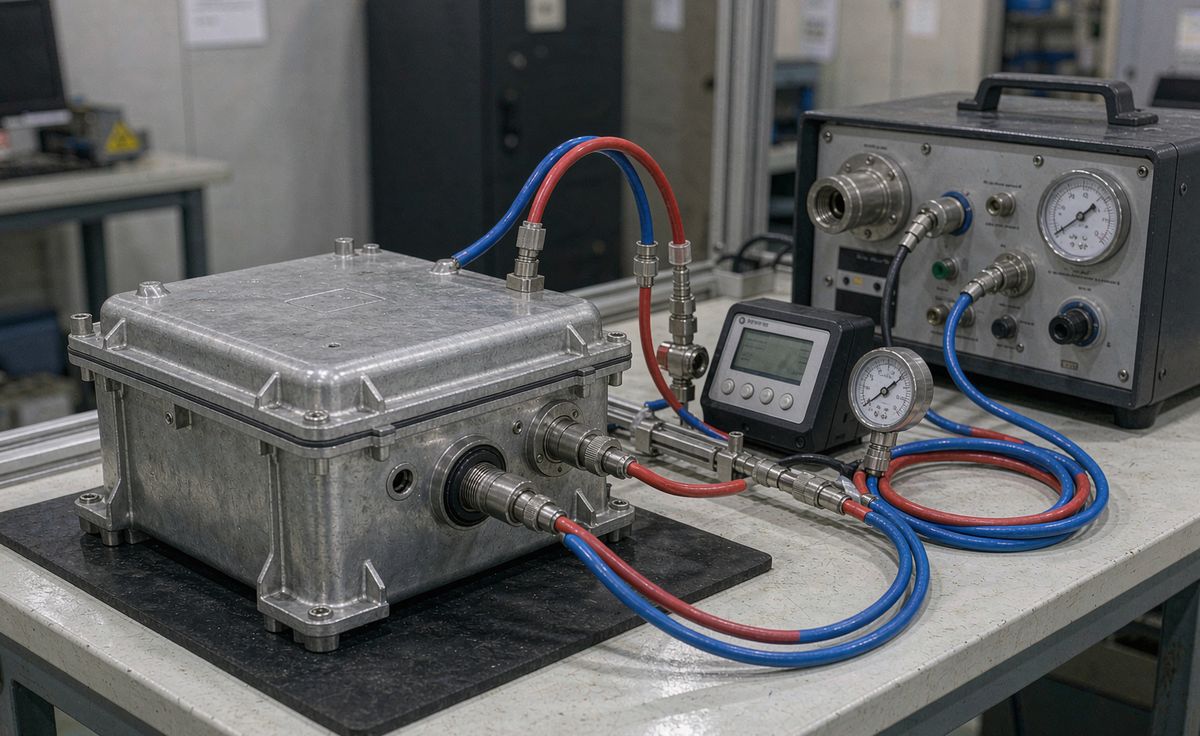
What does IP67 mean for an enclosure body?An IP rating comes from one sample passing the IEC 60529 test once. It covers the assembled box: body, lid, gasket and fasteners, not the body alone. We machine the gasket groove and the sealing face to your drawing. We leak test the assembly when the drawing calls for it. Send the drawing to info@aymetals.com, or reach us on WhatsApp at +86 133 0570 9557.
Request a Quote
Need a custom aluminum battery box for e-rickshaw or 3-wheeler EV? Send us your drawing or specs and we will reply within 24 hours.
WhatsApp UsEmail info@aymetals.com
WhatsApp: +86 133 0570 9557 | Email: info@aymetals.com
Related: How to Choose an Aluminum Battery Box for E-Rickshaws | Aluminum vs Steel vs Plastic Battery Enclosures
Related: How to Choose an Aluminum Battery Box for E-Rickshaws · Aluminum vs Steel vs Plastic Battery Enclosures · 6063 vs 6061 vs 6082: Which Aluminum Alloy for Battery Boxes · India E-Rickshaw Market in Numbers (2026)
RELATED NEWS
Need Aluminum Battery Enclosures?
From extrusion to CNC machining and anodizing, AOYIN delivers end-to-end manufacturing for EV battery housings.
Mobile Phone
Email:
Add:No 339-1 shangye village Gouxi Township Kecheng district Quzhou City, zhejiang province,China
Add:No 339-1 shangye village Gouxi Township Kecheng district Quzhou City, zhejiang province,China

WhatsApp