Quzhou Aoyin Metal Materials Co.,Ltd


How Battery Boxes Are Leak Tested (4 Methods Compared)
Blog
How Battery Boxes Are Leak Tested (4 Methods Compared)
Release time:
2026-09-13
Source


A 4-kg aluminum battery box with a 0.5 mm gap somewhere in its sealing face will pass a visual inspection and a 30-minute rain test — and still fail a real monsoon in Pune in July. The four methods used on battery enclosures today — pressure decay, differential pressure, helium sniff, and vacuum-chamber helium — find very different sizes of leak at very different costs. This guide walks through what each method actually measures, where each one lies about its sensitivity, and the eight lines to put in your RFQ so you know what your supplier is really running.
Table of Contents
Why leak testing matters more than people think
India's AIS 156 Phase 2 (in force since 31 March 2023 for L-category EVs including e-rickshaws) requires lithium battery packs to pass IPx7 — 1 m of water immersion for 30 minutes per IEC 60529. A typical aluminum battery enclosure is rated IP54 or IPx7 depending on the variant, and the entire quality story collapses if the box does not hold that pressure differential in production. For a 48V/100Ah LFP e-rickshaw pack, an undetected 0.1 mm leak can take the box from "passes lab test" to "fails first monsoon" — the failure mode that ends in warranty claims and a post on WhatsApp groups.
Industry data on the trade-off (海怀检测 2026 / 北检 2026):
Typical battery-box leak-rate spec: ≤1×10⁻⁶ Pa·m³/s (helium leak rate at the part level)
Standard pressure-decay acceptance test: 10 kPa pressure differential, 3 min hold, pressure drop ≤50 Pa
Differential-pressure sensitivity: 10⁻⁴ Pa·m³/s
Helium mass-spectrometer sensitivity: 10⁻¹² Pa·m³/s (eight orders of magnitude tighter)
The unit Pa·m³/s is the leak rate expressed as a pressure drop per unit volume per second. A battery box whose helium leak rate measures 1×10⁻⁶ Pa·m³/s has lost one millionth of a pascal of pressure per cubic meter of internal volume per second. At the IP67 level, that is not small.
The four methods compared
| Method | Typical sensitivity | Cycle time | Equipment cost | Where it fits |
|---|---|---|---|---|
| Pressure decay (直压法) | 10⁻² to 10⁻³ Pa·m³/s | 30-120 s | Low (USD 5-20k) | Production-line screening, low-cost programs |
| Differential pressure (差压法) | 10⁻⁴ Pa·m³/s | 60-180 s | Medium (USD 20-80k) | Critical parts, IPx7-rated battery enclosures |
| Helium sniff (吸枪法) | ~10⁻⁶ Pa·m³/s | 60-300 s/area | Medium-high (USD 50-150k) | Aftermarket, R&D leak location |
| Vacuum-chamber helium (真空箱法) | ≤1×10⁻⁶ Pa·m³/s (typ. industrial spec) | 180-600 s | High (USD 100-300k) | Whole-box final QC, high-IP programs |
Sources: 北检 2026 engineering reference; 海怀检测 2026 process specification; ISO 20485 (vacuum-chamber helium method).
1. Pressure decay (直压法)
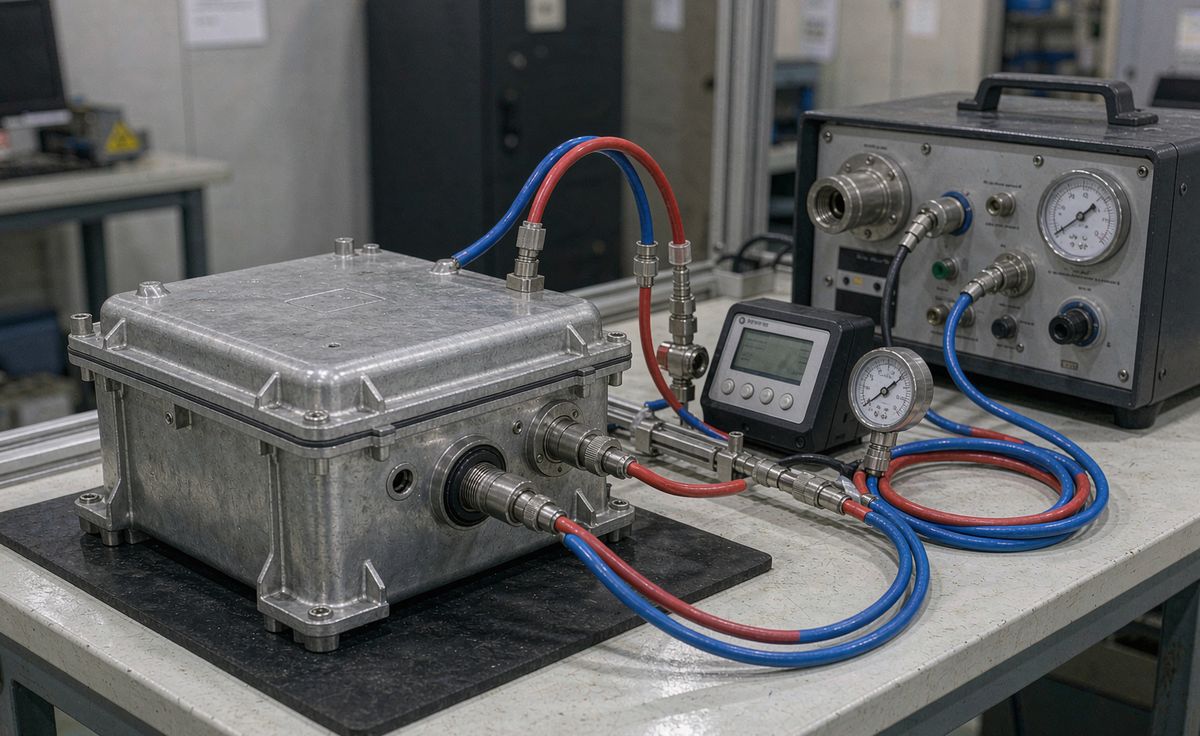
The simplest method: pressurize the box, isolate it, watch the gauge. If the pressure drops faster than the spec allows, the box leaks. Total equipment cost is 5-20k USD and the cycle time is the fastest of any method.
The catch is well-known: the measurement is temperature-sensitive. A 1 °C ambient change in a 100 L test chamber shifts the pressure by about 0.4%, which is large compared to the leak signal you're trying to detect. In production, the workarounds are long stabilization times (20-30% of the total cycle) and insulated or AC-controlled test chambers. For an e-rickshaw enclosure with a 5-10 L internal volume and an IP54 spec, pressure decay is adequate — the leak budget is loose enough that temperature drift doesn't matter. For an IPx7 pack, the rejection limit often sits too close to the temperature noise and the method fails.
2. Differential pressure (差压法)
Differential pressure solves the temperature problem with a reference volume: the system pressurizes both the test part and an identical reference volume (with no leaks) to the same pressure, isolates them, and watches the difference between the two. Because both volumes sit in the same ambient, temperature changes cancel out — only the actual leak on the test part moves the differential reading.
The technique lands at 10⁻⁴ Pa·m³/s sensitivity in commercial systems, cleanly resolving the leak rates that matter for IP67 enclosures. Cycle time is 60-180 s including stabilization, and the equipment is in the 20-80k USD bracket — modest enough that a serious battery-box line runs it as the standard QC station rather than a special test. For an e-rickshaw or three-wheeler battery enclosure, this is the method to ask for in the RFQ.
3. Helium sniff / sniffer probe (吸枪法)
Helium sniffing pushes the box's internal pressure up to 5-10 kPa with a helium mix, then moves a sniffer probe along the outside — welds, sealing faces, cable-gland entries, connector interfaces. The probe is connected to a helium mass spectrometer; a leak shows up as a spike in the helium reading. Sensitivity is around 10⁻⁶ Pa·m³/s, and cycle time depends on the operator's discipline (60-300 s for a careful perimeter scan). Equipment is in the 50-150k USD bracket.
Sniffing is the right method for R&D and failure analysis — when you have a failed part and need to know where the leak is — and for supplier qualification audits. It is the wrong method for thousands-of-units production pass/fail: sniffing is a quality-engineering tool, not a line test.
4. Vacuum-chamber helium (真空箱法)
The most sensitive method that is still economical for production, per the 海怀检测 process specification (2026) and ISO 20485:
Place the battery box in a vacuum chamber
Evacuate the chamber to ≤100 Pa
Fill the box's interior with 10-20% helium + 80-90% dry air (or N₂) mix (the mix keeps helium cost down)
Connect the chamber to a helium mass spectrometer
Run for a defined test cycle (typ. 3-10 min)
Pass/fail at a leak rate of ≤1×10⁻⁶ Pa·m³/s
The mix at step 3 is the practical engineering choice — 100% helium is faster and more sensitive, but recovery and recycle cost is significant; the 10-20% mix hits the spec at 1/5 to 1/10 the gas cost. Sensitivity at this spec is more than adequate for IPx7 verification, and the test is the de-facto standard for high-IP automotive battery enclosures in 2026. Cycle time is the slowest (180-600 s per part), but on a 30-60 s takt-time line it is run on AQL sampling rather than 100%, or the station is parallelized with multiple chambers.
The honest counterpoint: when you don't need helium
For a small-volume aftermarket repair program (a few hundred packs a year, retrofitting lead-acid vehicles to lithium), a helium mass-spectrometer test station is overkill. The capital cost is real — USD 100-300k for a vacuum-chamber system — and the cycle time doesn't pay back below ~1,000 parts/year.
For that program, differential pressure at 10⁻⁴ Pa·m³/s is sensitive enough to verify IPx7; pressure decay is acceptable for IP54 parts where the leak budget is generous; helium sniff is a one-off tool you hire for failure analysis, not buy. The audit-welcome test for a low-volume program is to send 5-10 parts per lot to an independent lab for vacuum-chamber helium verification. Spending USD 100-300k on your own chamber is not justified until your volume or quality stakes justify it.
RFQ checklist: 8 lines to put in your supplier inquiry
Target leak rate: write it in Pa·m³/s (e.g. "≤1×10⁻⁶ Pa·m³/s") — not "waterproof" or "IP67 guaranteed."
Test method: name the method (pressure decay / differential pressure / vacuum-chamber helium). If they don't name it, they probably don't run it.
Test pressure and stabilization time: e.g. "10 kPa, 30 s stabilization, 180 s test."
Acceptance criterion: e.g. "pressure drop ≤50 Pa over 3 min" for pressure decay.
Reference volume for differential pressure: same-size reference part in the same test cell.
Helium mix ratio and vacuum level (if helium method): e.g. "10-20% He + 80-90% dry air; chamber ≤100 Pa."
Sampling plan: 100% line test, or AQL sampling (and what AQL).
Calibration cadence: when was the reference leak last calibrated? Helium mass-spec drift is real and needs annual recalibration with a calibrated leak.
A supplier who answers all eight with numbers has a real test station. A supplier who says "we do leak testing" without numbers is doing pressure decay and hoping you don't ask.
FAQ
What leak rate corresponds to IP67 on a battery box?
There is no single number, because IP67 is a test (1 m immersion for 30 min), not a leak rate. In practice, an enclosure that passes IP67 typically shows a helium leak rate in the 10⁻⁶ Pa·m³/s range or better. Suppliers that publish a leak-rate number rather than just "IP67 rated" are doing real engineering.
Can pressure-decay testing verify IP67?
It can — at the limit. A well-stabilized pressure-decay station with adequate temperature control can resolve leak rates near 10⁻³ Pa·m³/s, which is loose compared to the 10⁻⁶ typical of a true IP67 part. The risk is passing parts that are technically IP67 but only by a small margin. Differential pressure or helium testing is more reliable for IPx7-rated enclosures.
Why is helium used for leak testing at all?
Helium is the smallest practical gas molecule (after hydrogen, which is unsafe), inert, present at only ~5 ppm in the atmosphere (so any spike is signal, not noise), and mass spectrometers can detect it at concentrations down to 10⁻¹² Pa·m³/s. That combination is what makes ultra-sensitive leak testing practical.
Is helium leak testing destructive?
No. The vacuum-chamber method is non-destructive — the box is not altered. The sniffer method is also non-destructive. Both methods leave the box ready for further processing or shipment. The only destruction is on parts that fail the test, which are sent to rework (or scrap if unreworkable).
What about the pressure-equalization membrane? Doesn't that defeat a leak test?
A pressure-equalization vent (typically Gore-Tex or similar membrane) is designed to pass air at a low rate to equalize pressure during temperature cycles, while blocking liquid water. Leak testing is done with the vent in place — the test pressure is selected so that the vent's flow is below the acceptance threshold (typically much lower than the spec). The test still verifies the box's sealing joints, not the vent.
Related: IP54 vs IP65 vs IP67: What Battery Box Ratings Actually Mean · Lead-Acid to Lithium: What Changes in Your E-Rickshaw Battery Box · How Aluminum Extrusion Works for Battery Boxes
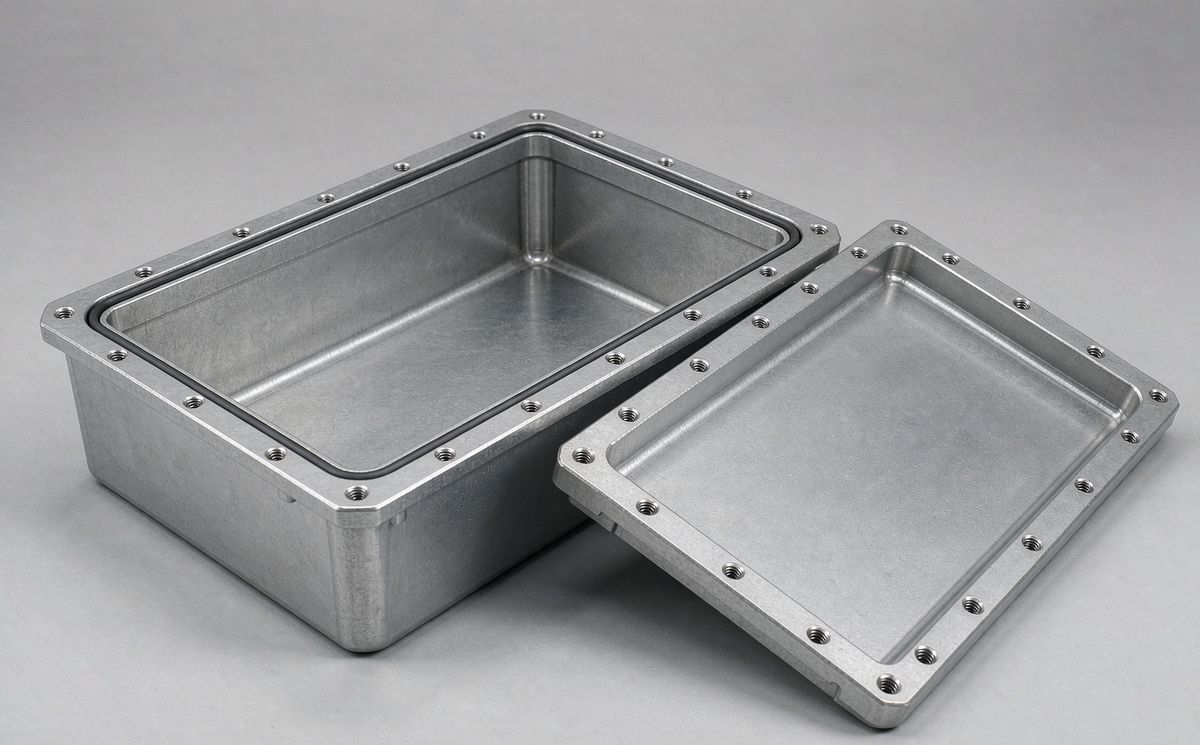
Photo: AOYIN production-render illustration. Not a client-specific product photo.
RELATED NEWS

Need Aluminum Battery Enclosures?
From extrusion to CNC machining and anodizing, AOYIN delivers end-to-end manufacturing for EV battery housings.
Email:
Add:No 339-1 shangye village Gouxi Township Kecheng district Quzhou City, zhejiang province,China
Add:No 339-1 shangye village Gouxi Township Kecheng district Quzhou City, zhejiang province,China
-
-
-
-

WhatsApp