Quzhou Aoyin Metal Materials Co.,Ltd


How to Specify an E-Rickshaw Battery Box: 8 Dimensions to Fix Before You Send the Drawing
Blog
How to Specify an E-Rickshaw Battery Box: 8 Dimensions to Fix Before You Send the Drawing
Release time:
2026-09-26
Source


- The quote you get back is only as good as the drawing you send
- Why this step costs real money when it goes wrong
- The 8 items, with typical values and what each one does to your cost
- Which production path fits your quantity
- What goes wrong when an item is left open
- The 9-point checklist to send with the drawing
- Red flags while you compare suppliers
- What we run at Aoyin Metals
- Frequently asked questions
The quote you get back is only as good as the drawing you send
You need 500 e-rickshaw battery boxes for a new LFP pack, and the drawing is half finished: outer envelope, a wall thickness someone remembered from the last project, "surface: anodized". You send it to three suppliers. Within a day you have three quotes spread 40% apart — and no way to tell which one understood the box and which one just multiplied material cost by a factor.
The gap is not in their pricing. It is in the eight specification items your drawing left open. Every one of them has a cost consequence, and every supplier fills the blanks differently. Fix all eight before the drawing leaves your desk, and the three quotes come back comparable — sometimes within a few percent.
Why this step costs real money when it goes wrong
Two numbers show what an open specification item is worth. A dedicated extrusion die for a battery box profile costs roughly 3,000–8,000 RMB and takes 2–3 weeks; if the wall thickness or the corner radii were wrong in the first drawing, that die is scrap and the clock restarts. And a sealing face that arrives out of flat does not show up at incoming inspection — it shows up as monsoon water ingress, on vehicles already sold, under your warranty.
Specification errors are cheap to fix on paper and brutally expensive to fix in metal. That asymmetry is the entire argument for the eight items below.
The 8 items, with typical values and what each one does to your cost
| # | Item | Typical value | What it means for your cost and lead time |
|---|---|---|---|
| 1 | Alloy and temper | 6063-T5 for extruded housings; 6061-T6 where strength leads | Decides the die design, the finish quality and the price band |
| 2 | Wall thickness | ≥1.2 mm for extruded walls | Below that, extrusion ratio and scrap rate climb — and so does your unit price |
| 3 | Mounting interface | hole pattern, bolt size, torque spec | Missing torque spec = cracked bosses in the field; it costs nothing on the drawing |
| 4 | IP sealing design | IP54 / IP65 / IP67 per IEC 60529 | Decides gasket groove, flatness callout and the leak test each box must pass |
| 5 | Joining method | FSW, MIG, or bolted flange | Decides the production sequence: weld first, then anodize — never after |
| 6 | Finish and film thickness | Type II 8–15 µm per ISO 7599 | Wear faces may need Type III; grounding points must be masked |
| 7 | Tolerances and their basis | GB/T 6892 general ±0.25 or precision ±0.15 on a 2.0 mm wall; state before/after anodizing | Precision class costs more; "after anodizing" vs "before" changes the machining route |
| 8 | Order volume | prototype 1–10 / pilot 50–500 / 5,000+ | Volume picks the production path — and the die decision inside it |
Item 7 is the one that generates the most disputes. If the drawing does not state whether dimensions apply before or after finishing, a 50 µm hard-anodized surface grows about 17 µm outward per face — and your "interference fit" quietly becomes a press fit.
Which production path fits your quantity
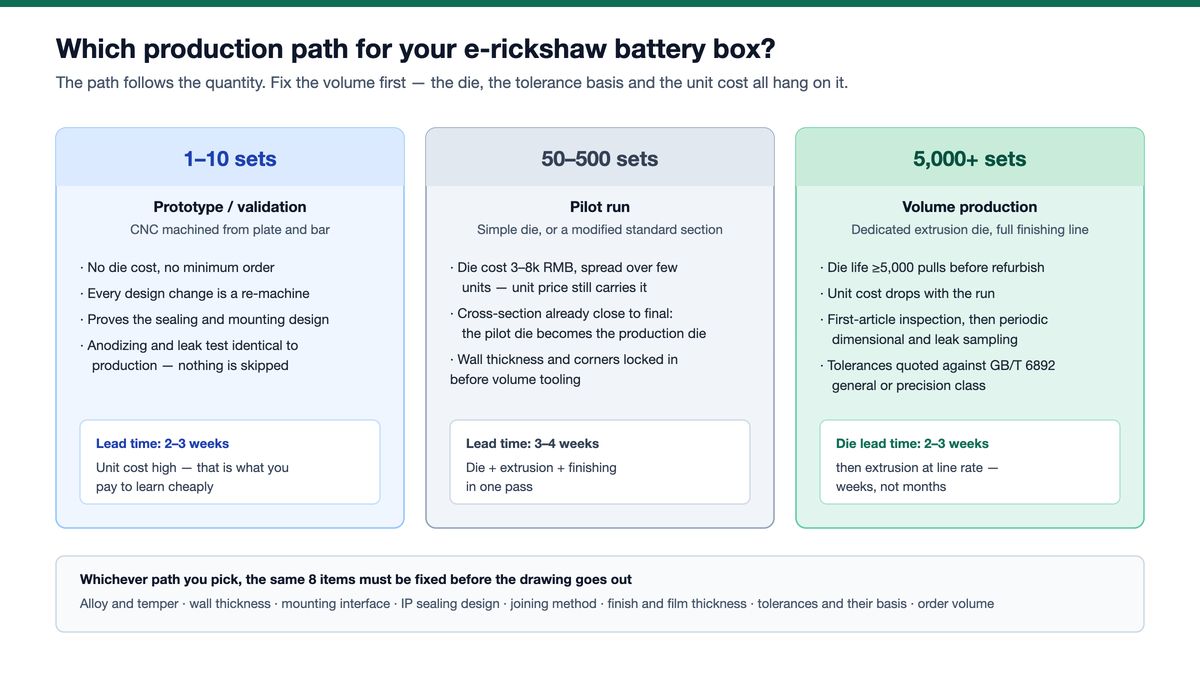
- 1–10 sets (prototype): CNC from plate. No die, no MOQ, and every revision is a re-machine — that is the point. Prove the sealing and mounting design here, with the same anodizing and leak test you expect in production.
- 50–500 sets (pilot): a simple die or a modified standard section. The die costs 3–8k RMB and the unit price still carries it, but the cross-section is now close to final — a pilot die that survives the pilot becomes the production die.
- 5,000+ sets (volume): a dedicated extrusion die with a life of 5,000+ pulls before refurbishment, first-article inspection, then periodic dimensional and leak sampling.
The common mistake is jumping from prototype straight to a volume die with an unproven section. The pilot run exists to absorb exactly that risk, and it costs one die plus three weeks.
What goes wrong when an item is left open
- Twisted or bowed profiles. Cause: unbalanced section — thin walls one side, thick the other. Prevention: keep the wall thickness ratio within about 2:1 across the section, or the profile leaves the press with built-in stress that machining cannot remove.
- Cracked inside corners. Cause: inside radius under 2 mm concentrates stress in both the die and the part. Prevention: inside R ≥ 2 mm, outside R ≥ 1 mm, draft 0.5–1° where the section allows.
- Sealing face out of flat. Cause: no flatness callout on the gasket face. Prevention: put a flatness limit on the sealing face on the drawing and hold the supplier to it at incoming inspection — "it looks flat" is not a specification.
- Binding after finishing. Cause: film growth not accounted for. Prevention: state on the drawing whether tolerances are before or after anodizing, and which faces are masked.
The 9-point checklist to send with the drawing
- Alloy and temper stated, not implied
- Minimum wall thickness marked on the thinnest feature
- Mounting hole pattern with bolt size and torque
- IP rating per IEC 60529, and which test proves it
- Joining method — and the weld-then-anodize sequence written down
- Film thickness and type, with grounding points flagged for masking
- Tolerance class per GB/T 6892, and whether dimensions are pre- or post-finish
- Sealing-face flatness called out with a number
- Order volume and first delivery date
Red flags while you compare suppliers
- A detailed quote within hours, with no questions about the eight items. A supplier who understood the box has questions; a trader has a price list.
- "Wall thickness is no problem" on a section where your own drawing implies 0.8 mm. Extrusion economics say otherwise.
- No answer when you ask which leak test each finished box passes. If they cannot name the test, they are not running one.
- Certificates that do not name the issuing body, or a single glossy brochure instead of a dimensioned sample report.
What we run at Aoyin Metals
We build aluminum battery enclosures for e-rickshaw and e-scooter packs through an integrated production network: extrusion up to 5,000 t presses, CNC machining, friction stir welding, anodizing and leak testing under one quality system, with audit welcome at every stage. If you send the eight items above with your enquiry, the quote you get back will match them line by line.
Frequently asked questions
Can I get prototypes without opening a die? Yes. Quantities of 1–10 are CNC-machined from plate with no tooling cost. The trade-off is unit price and the fact that every revision re-enters machining — which is exactly what a prototype round is for.
What does a dedicated extrusion die cost, and who owns it? For a battery box profile, typically 3,000–8,000 RMB with a 2–3 week lead time. Ownership terms should be stated in the purchase contract; tooling paid for by the buyer is normally the buyer's asset.
Why do quotes for the same drawing differ so much? Because the drawing left specification items open, and each supplier filled them differently — different assumed alloy, tolerance class, finish, or test level. Fix the eight items and the quotes converge.
Do I need IP67 for an e-rickshaw battery box? Not always. IP54 handles splash and dust for under-seat locations; IP65 covers wash-down; IP67 is required for packs where immersion is a regulatory or usage reality. Choose by mounting location, then let the sealing design follow.
Should tolerances be stated before or after anodizing? After, for mating dimensions — the film grows about one third of its thickness outward. State the basis explicitly on the drawing, or the finished part and the drawing will disagree by 10–20 µm per surface.
Send the eight items with your enquiry to info@aymetals.com, or start from the e-rickshaw battery box range and we will take it from there.
Related guides
- How to choose an e-rickshaw battery box — the full selection checklist
- What anodizing does to a battery box — film thickness, hardness, limits
- Friction stir welding for battery trays — the joining option item 5 points to
- IP54 vs IP65 vs IP67 — picking the rating behind item 4
- How aluminum extrusion works — why wall thickness and corners behave as they do
- Custom OEM solutions — from drawing to sealed, tested boxes
Diagram: Aoyin Metals schematics. Die cost and lead-time figures reflect typical quotes for extruded battery box profiles; tolerance classes cite GB/T 6892.
RELATED NEWS
Need Aluminum Battery Enclosures?
From extrusion to CNC machining and anodizing, AOYIN delivers end-to-end manufacturing for EV battery housings.
Email:
Add:No 339-1 shangye village Gouxi Township Kecheng district Quzhou City, zhejiang province,China
Add:No 339-1 shangye village Gouxi Township Kecheng district Quzhou City, zhejiang province,China
-
-
-
-

WhatsApp