Quzhou Aoyin Metal Materials Co.,Ltd


What Anodizing Actually Does to an Aluminum Battery Box
Blog
What Anodizing Actually Does to an Aluminum Battery Box
Release time:
2026-09-26
Source


- Why a bare aluminum box does not stay bare for long
- What anodizing actually is, and what it is not
- The film grows in two directions, and that decides everything
- Type II vs Type III: the one comparison that matters
- What the numbers say when the film is done right
- Why anodized boxes still corrode
- Where anodizing reaches its limits
- Frequently asked questions
Why a bare aluminum box does not stay bare for long
An e-rickshaw battery box that leaves the line with a bare mill finish looks fine on delivery day. Six monsoon months of standing water, humidity and road dust later, the same surface carries a chalky white powder that wipes onto gloves and axle straps — aluminum oxide, flaking off the metal that formed it. Boxes from the same batch that went through anodizing show none of it. The difference is a film a few times thinner than a human hair, grown onto the surface in a tank of sulfuric acid.
That film is the reason anodizing is the default finish for aluminum battery enclosures. But most people specifying it know the word, not the mechanism — and the mechanism is exactly what decides whether the film protects the box or causes the next problem.
What anodizing actually is, and what it is not
Anodizing is not paint, not plating, and not a layer glued onto the metal. It is an electrochemical conversion: the aluminum part is made the anode in an electrolyte, and the surface metal itself reacts with oxygen to form aluminum oxide — the same hard ceramic that grinding wheels and sandpaper are made of. A useful way to picture it: it is not tiling a wall, it is firing the wall surface into ceramic.
Because the film is converted from the substrate rather than added to it, it cannot peel the way a coating can. It also does not grow only outward. Roughly one third of the film thickness builds above the original surface, and two thirds consume metal below it. That single ratio explains most of what follows — the dimensional changes, the welding conflicts, and the reason corners behave differently from flat faces.
The film grows in two directions, and that decides everything
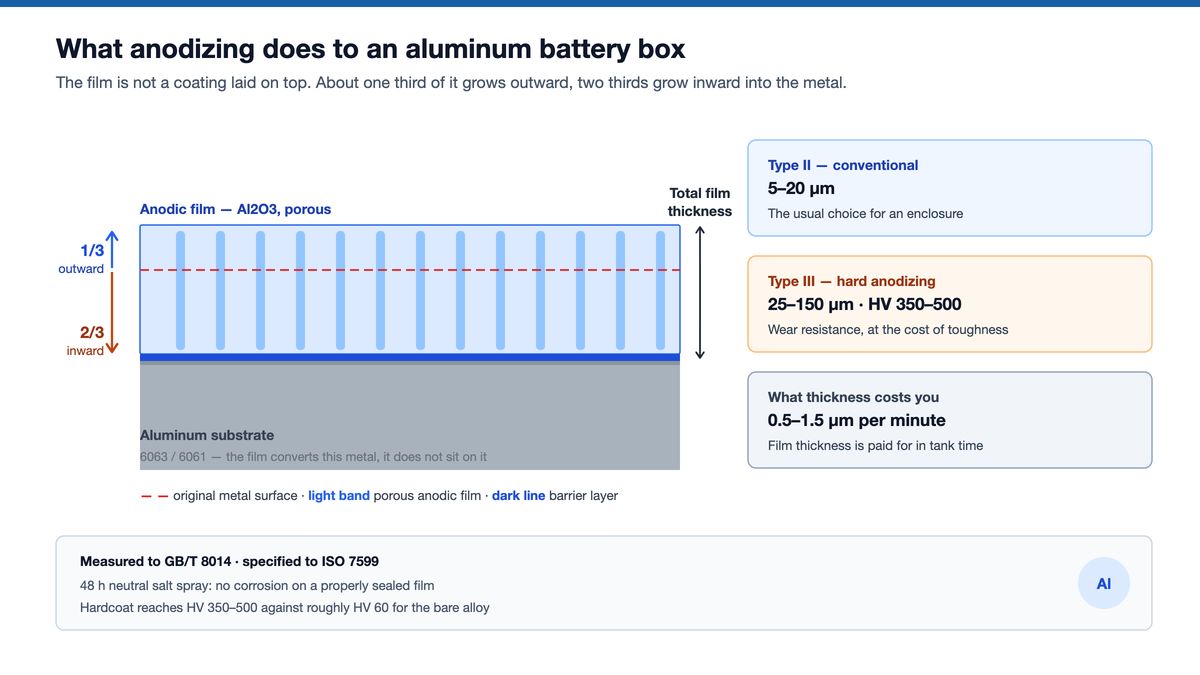
The film is two layers doing two different jobs. The outer layer is porous — billions of pores per square centimetre, each a few tens of nanometres wide — which is what lets the film take dye, and what makes sealing (hot-water or salt-based pore closure) the step that actually locks in corrosion resistance. Against the metal sits the barrier layer: dense, non-porous, and about 1.0–1.4 nm thick per volt of applied voltage.
The growth direction is the part buyers most often miss. A 50 µm Type III film pushes the surface up by roughly 17 µm on each face — about a third of a typical machining tolerance band, eaten before the box ever meets its mating part. This is why hard-anodized parts are often specified pre-finished, or toleranced with the film growth written on the drawing.
Type II vs Type III: the one comparison that matters
Both types run in sulfuric acid; they differ in temperature, current density and what they are for.
| Property | Type II (conventional) | Type III (hard) | What it means for your box |
|---|---|---|---|
| Film thickness | 5–20 µm | 25–150 µm | Type II protects; Type III also resists wear |
| Microhardness | ~HV 200–350 | HV 350–500 | Hardcoat shrugs off abrasion from debris and mounting vibration |
| Bath temperature | 18–22 °C | 0–5 °C | Cold bath costs energy and tighter process control |
| Growth rate | 0.5–1.5 µm/min | similar, slower per µm | Thickness is paid for in tank time, not material |
| Typical use on enclosures | standard corrosion protection, dyeable | wear faces, sealing surfaces, high-abrasion zones | Most e-rickshaw boxes use Type II; wear zones go Type III |
Type III at full thickness is also where brittleness starts — more on that below.
What the numbers say when the film is done right
Film thickness is measured by eddy current or microscopy to GB/T 8014, and the process itself is specified to ISO 7599 (sulfuric acid anodizing) with hard anodizing covered by ISO 10074. On a properly sealed Type II film, 48 hours of neutral salt spray per ISO 9227 produces no visible corrosion. The oxide itself is a serious ceramic: melting point around 2,050 °C, electrical breakdown in the kilovolt range for hard films — the film is, in fact, an insulator.
That last property cuts both ways. An anodized box does not need an extra insulating layer between it and the pack. But every grounding point, every bonding strap and every conductive gasket path has to be designed around the film — masked before anodizing, or machined back afterwards.
Why anodized boxes still corrode
| Root cause | What it looks like in the field | The number that matters |
|---|---|---|
| Poor sealing | white bloom or pitting after the first wet season | sealed-film quality is tested by dye stain or admittance methods (ISO 2143 family); an unsealed film fails salt spray in hours, not days |
| Sharp corners | chipped, grey, or burnt film on edges | corners tighter than about 0.5 mm build thin, stressed film; radius edges wherever the drawing allows |
| Dimensional growth | mating parts bind after finishing | 1/3 of film grows outward: a 50 µm hardcoat adds ~17 µm per surface |
| Welding order | dull, patchy, or bare weld seams | the joint area must be anodized after welding; anodize-then-weld leaves the seam unprotected |
| Alloy choice | dark, blotchy film on some alloys | copper- and silicon-bearing alloys (6061) film less uniformly than 6063 |
Two of these deserve emphasis. Sealing is the step plants skip when the schedule is tight, and it is the step the salt-spray result actually depends on — thickness without sealing buys almost nothing. And welding order is a sequencing decision made on the production plan, not in the anodizing shop: if the enclosure is welded after anodizing, the weld zone has no film at all, and that is precisely where corrosion starts on real failed boxes.
This is also where alloy choice comes back. The uniformity of the film is a property of the alloy as much as the bath — which is why the 6063 vs 6061 question and the finishing question are really one question.
Where anodizing reaches its limits
The film is a ceramic on a metal that bends, and three consequences follow:
- It cracks where the metal deforms. A hardcoat does not tolerate plastic deformation: flex a hard-anodized flange and the film micro-cracks with it, opening corrosion paths along the crack lines. Regions expected to bend or take impact are better left thin-film or uncoated.
- It is an insulator. Grounding, bonding and EMC gasket paths all need masking or post-machining. On a battery box with BMS ground points this is a design input, not an afterthought.
- It will not match batch-to-batch. 6063 and 6061 in the same bath come out different shades, and dyed films drift between batches. If two boxes sit next to each other on the vehicle, specify them from the same alloy and the same anodizing run.
And one thing anodizing cannot do at all: repair. A box that has already corroded cannot be re-anodized back to new — rework means stripping the old film in caustic, which removes metal and dimensions with it.
Frequently asked questions
Is anodizing a coating that can peel off? No. The film is converted from the surface metal itself, so there is no boundary for it to separate from. It wears with the metal and, unlike paint, it cannot flake or blister.
Why does the film grow inward as well as outward? The oxide consumes aluminum as it forms. About one third of the final thickness builds above the original surface and two thirds grow into it, which is why finished dimensions move and why drawings must state whether tolerances are before or after anodizing.
What film thickness does a battery enclosure need? For general corrosion protection on a vehicle-mounted box, conventional Type II film in the 8–15 µm range is the common specification. Wear faces and mounting interfaces that see abrasion go to Type III, typically 25–50 µm.
Does a thicker film always mean better corrosion resistance? No. Past a moderate thickness, corrosion resistance depends far more on sealing quality than on thickness. A well-sealed 10 µm film outperforms a poorly sealed 50 µm one in salt spray.
Can you anodize after welding? You can, and for a battery box you should. Welding after anodizing burns off the film at the joint and leaves bare, unprotected aluminum exactly where stresses are highest. The correct order is weld first, then anodize.
If you are weighing hardcoat against conventional anodizing for a new enclosure, send the alloy and the working environment to info@aymetals.com — we will tell you what the film specification should say before it goes on the drawing.
Related guides
- Aluminum battery box materials — alloys, tempers and finishes in one place
- How aluminum battery boxes are made — the full process route
- 6063 vs 6061 vs 6082 — why the alloy decides the film quality too
- Small anodized battery shell — Type II finished enclosure example
- Square anodized battery power pack — anodized pack housing
- E-rickshaw battery boxes — enclosures built for monsoon duty
Diagram: Aoyin Metals schematics. Data points reflect published process specifications and standard test methods cited in the text.
RELATED NEWS

Need Aluminum Battery Enclosures?
From extrusion to CNC machining and anodizing, AOYIN delivers end-to-end manufacturing for EV battery housings.
Email:
Add:No 339-1 shangye village Gouxi Township Kecheng district Quzhou City, zhejiang province,China
Add:No 339-1 shangye village Gouxi Township Kecheng district Quzhou City, zhejiang province,China
-
-
-
-

WhatsApp