Quzhou Aoyin Metal Materials Co.,Ltd


How to Read a Leak Test Report for Battery Trays
Blog
How to Read a Leak Test Report for Battery Trays
Release time:
2026-10-09
Source


The report arrives after the boxes do
The leak test report is the only document that tells you whether the enclosure you are about to build into a pack is actually sealed — and it is usually the one nobody reads. A shipment of 300 battery trays lands with a packing list, a certificate of conformity and a one-page test report. The buyer checks the quantity, signs for the pallets, and the report goes into a folder. Six weeks later, three trays come back from the field with water inside.
The failure was already visible in that report. It said "leak test: passed" without naming the method, without a leak rate, and without a serial number tying the result to any tray. Nothing in it was false; none of it was checkable.
Why a bad report costs more than no report
A report you trust wrongly is worse than no report, because it closes the question. Price the two directions. A tray that leaks in service takes the pack with it: cells, BMS and harness, plus the labor to pull the pack off a vehicle already sold. Under AIS 156 Phase 2, lithium traction packs on L-category vehicles in India have had to meet IPx7 since 31 March 2023 — one meter of immersion for 30 minutes per IEC 60529, as set out in IP54 vs IP65 vs IP67 — so a sealing failure is also a compliance question.
The other direction is cheap: asking for four more fields costs an email, and re-testing 5–10 parts per lot at an outside laboratory costs a few hundred dollars. Both are trivial against one field failure, which is why the checklist below belongs with the enquiry and not with the claim.
The 9 fields a real leak test report carries
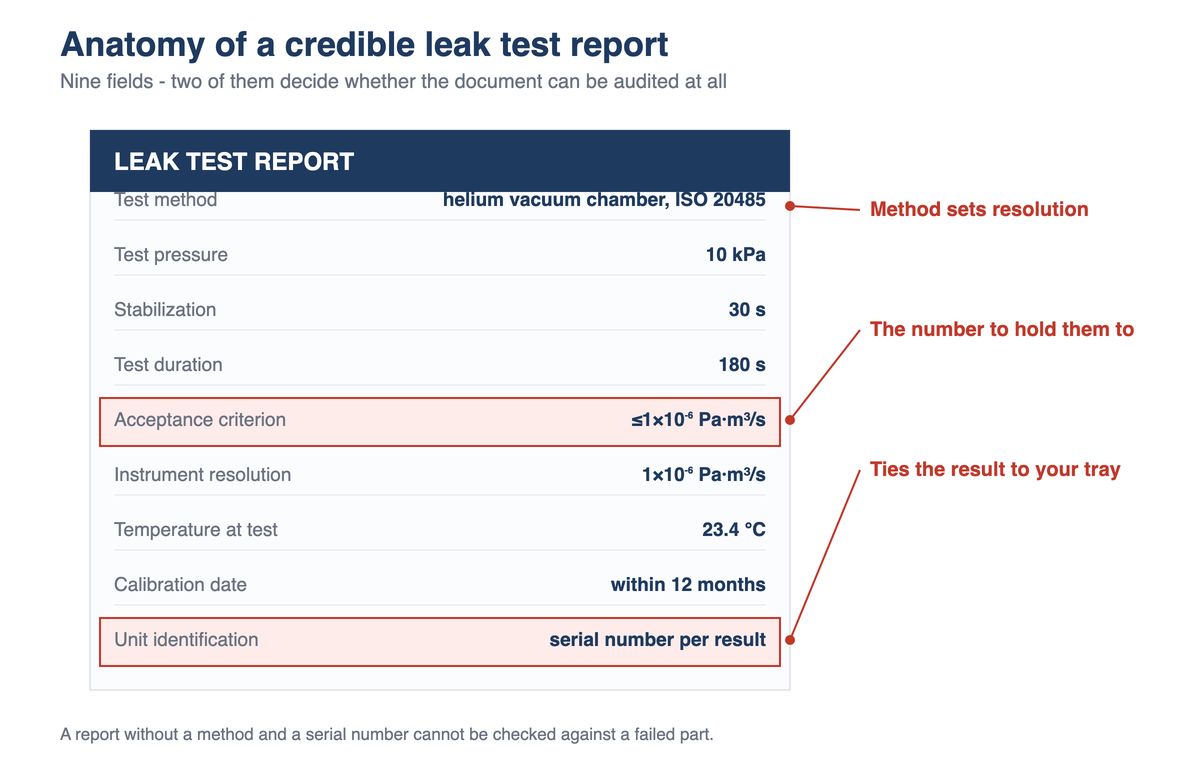
A credible report names the method, the pressure, the stabilization, the acceptance criterion and the unit it applies to — the other four fields are what let you audit it later. Anything missing from this list is a gap you are being asked to fill with trust.
| Report field | What a credible value looks like | Impact on your acceptance |
|---|---|---|
| Test method | named: pressure decay, differential pressure, or helium vacuum chamber per ISO 20485 | The method sets the resolution; without it the number means nothing |
| Test pressure | 10 kPa for pressure screens; 5–10 kPa for helium sniffing | Wrong pressure invalidates the result on a vented enclosure |
| Stabilization time | ≥30 s, stated | Skipping it converts thermal drift into false passes |
| Test duration | 180 s typical for differential pressure | Short tests under-detect slow leaks |
| Acceptance criterion | ≤50 Pa drop (screen); ≤1×10⁻⁶ Pa·m³/s (helium) | A report without a criterion cannot fail anything |
| Instrument resolution | 10⁻⁴ Pa·m³/s for differential pressure | Tells you the smallest leak the station could see |
| Temperature at test | recorded, within ±1 °C | A 1 °C shift moves a 100-litre reading by roughly 0.4% |
| Calibration date | reference leak calibrated within 12 months | An uncalibrated instrument produces confident, meaningless numbers |
| Unit identification | serial number or lot ID per result | Batch-level "pass" cannot be traced to a failed tray |
Two fields do most of the work. Resolution tells you what the station was physically capable of detecting; the acceptance criterion tells you what the supplier actually promised — a report can honestly pass a tray against a criterion far looser than the one you assumed. The distinction between what production screening can see and what a type test can measure is set out in how battery boxes are leak tested, and the method set behind it in the sealing and leak testing hub.
Which report your volume actually needs
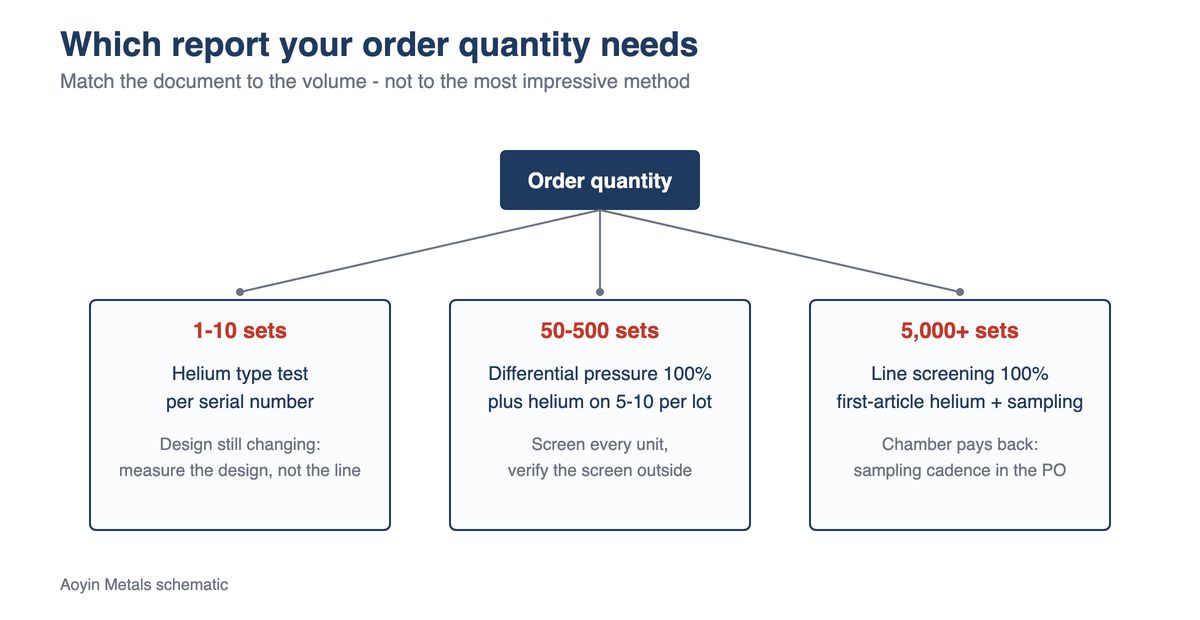
Match the report to the quantity, not to the most impressive method on the list. Asking a 50-piece pilot run for full helium documentation adds cost without adding assurance; accepting a visual check on a 5,000-piece program is where the money goes.
1–10 sets (prototype): helium vacuum-chamber report per serial number. The enclosure design is still changing, and the type-test number is what tells you the design works. Cost is irrelevant at this quantity.
50–500 sets (pilot): differential-pressure screening on every unit, plus helium verification on 5–10 parts per lot at an independent laboratory. The screened report proves consistency; the sampled helium report proves the screen is calibrated against reality.
5,000+ sets (volume): line-side differential pressure at 100%, first-article helium type test, then periodic sampling with a stated cadence. Unless your annual volume justifies the chamber, the rational setup is screening in-house plus outside verification at an independent laboratory.
The mistake in both directions is the same: asking one document to do another's job. The report should say which test it is.
How a passing report hides a leaking box
Most false passes are not falsified results — they are real measurements read against the wrong criterion. Six patterns account for nearly all of them:
| What the report shows | Root cause | Prevention, with the number |
|---|---|---|
| "IP67 compliant", no leak rate | the test was a visual or immersion check | require a leak rate in Pa·m³/s with the method named |
| One "pass" for the whole batch | results not captured per unit | require a result row per serial number |
| No stabilization time stated | thermal drift read as seal performance | require ≥30 s stabilization and the test temperature recorded |
| Differential pressure claiming 10⁻⁶ | resolution quoted from the wrong instrument | differential pressure resolves 10⁻⁴; 10⁻⁶ belongs to helium |
| Pass at 08:00, fail at 17:00 | test cell next to a loading dock | require the test cell temperature band, ±1 °C |
| Calibration date over a year old | reference leak never re-certified | require calibration within 12 months, with the certificate number |
The third one deserves emphasis, because it is invisible in the finished number. A 30 s stabilization window against a 180 s test is about 15% of the cycle, and cutting it is the easiest way to raise throughput. The report looks identical either way.
The 9-point checklist before you accept the shipment
Test method named — pressure decay, differential pressure, or helium per ISO 20485
Test pressure stated in kPa, and whether the pressure-equalisation vent was blocked
Stabilization time ≥30 s, written on the report
Acceptance criterion with a number: Pa drop or Pa·m³/s
Instrument resolution stated, so you know the detection floor
Test temperature recorded, within ±1 °C
Calibration date within 12 months, with the reference-leak certificate number
A result row per serial number, not a batch statement
Sample re-test clause in the purchase order: 5–10 parts per lot, independent laboratory
Send the nine fields with the enquiry, not after delivery. A supplier running the test already has all nine; a trader has to go and ask someone.
Red flags in a leak test report
"IP67 passed" with no leak rate. IP67 is a test defined by IEC 60529, not a number. A report quoting only the code was written, not measured.
No equipment identity. No method, no instrument, no serial — nothing to audit six months later.
One report reused across lots. Same file number, same date, three shipments. The test was run once, if at all.
A criterion looser than your drawing. The report is honest and still worthless: it tells you the box passed their number.
No answer when you ask which test each finished tray passes. If the name of the method cannot be produced in one email, the method is not running.
Certificates without an issuing body, or a glossy brochure in place of a dimensioned sample report.
Differential pressure screening and helium type testing
Every unit gets screened on the line; first articles and sampled lots get the helium number.
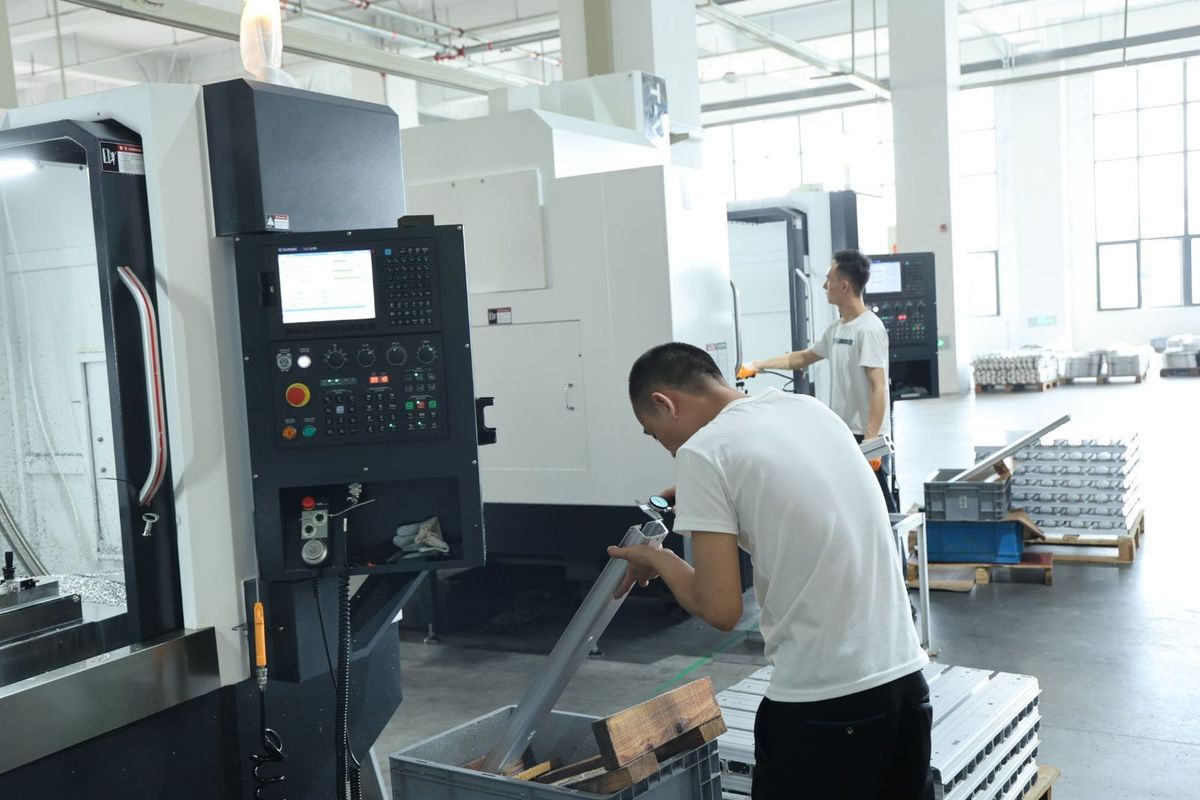
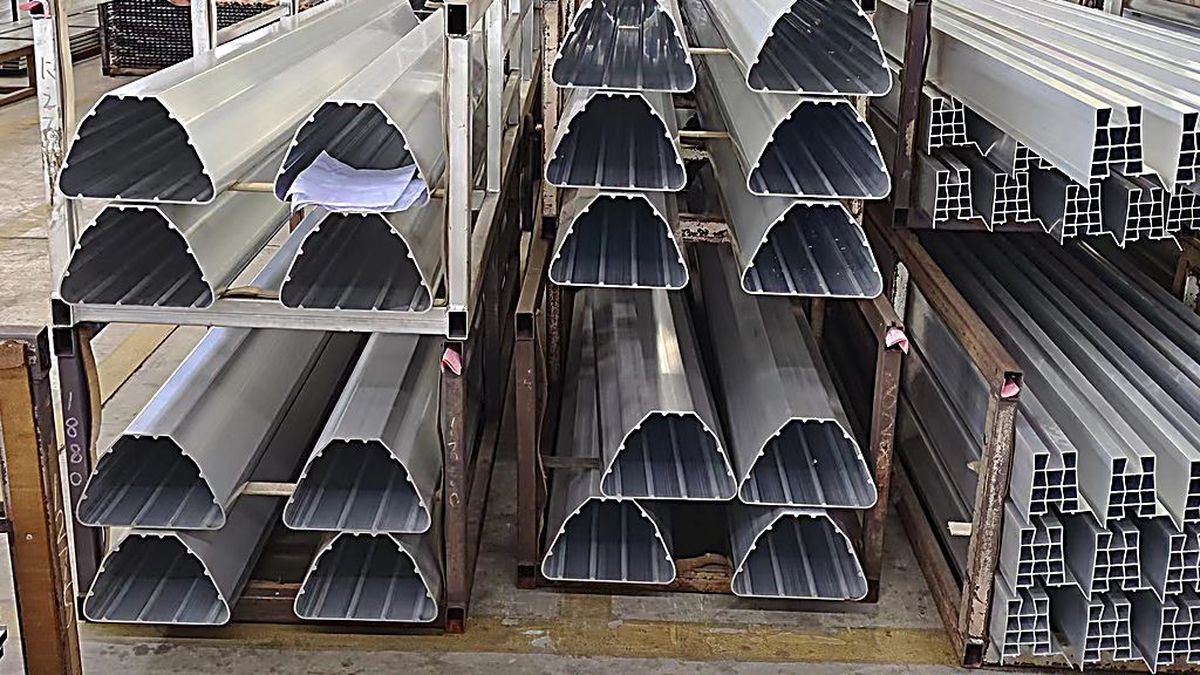
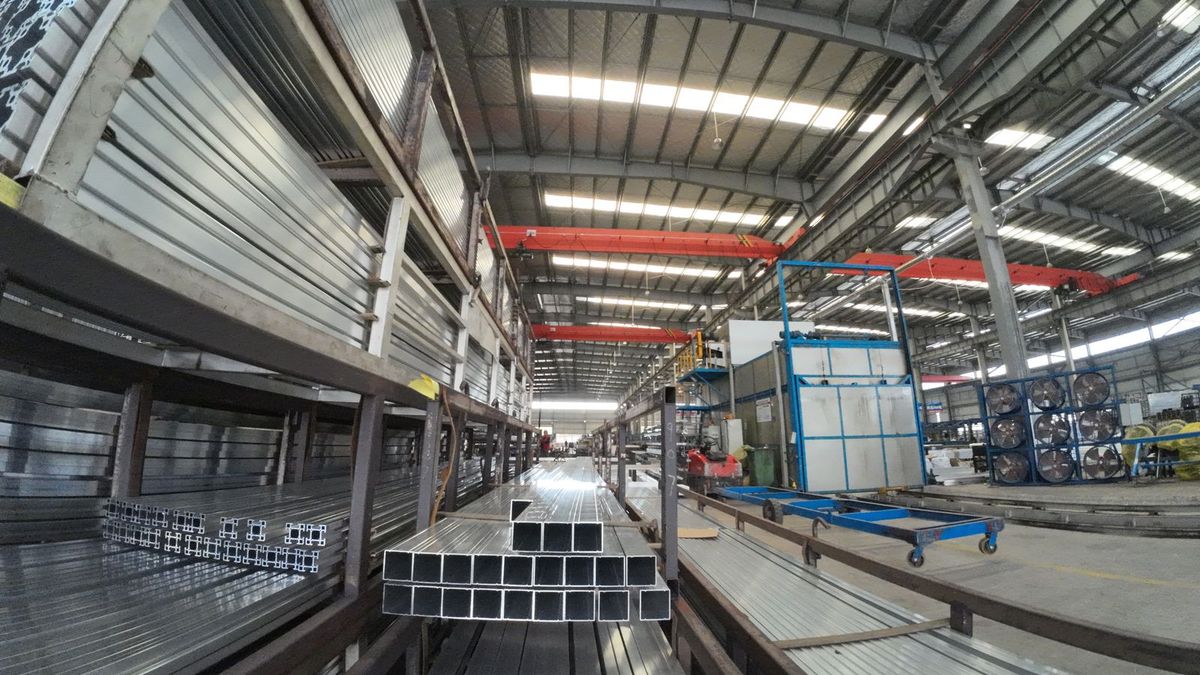
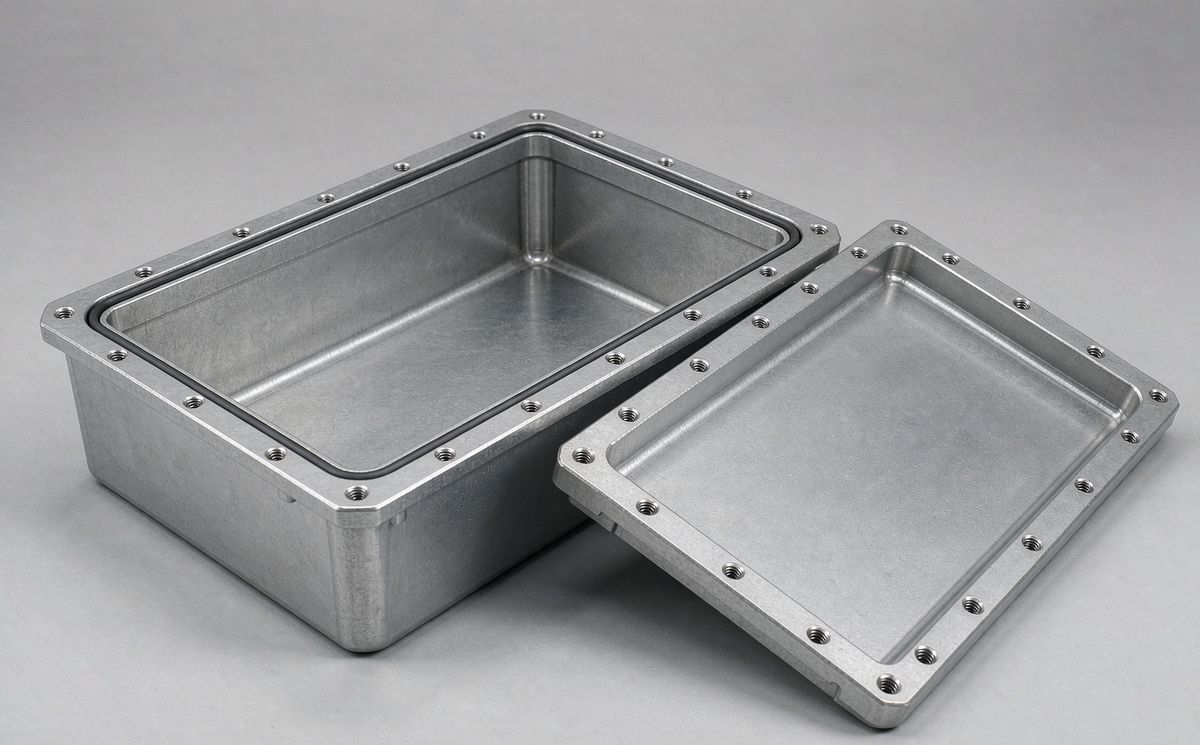
Aluminium battery enclosures for e-rickshaw and e-scooter packs run through an integrated production network: extrusion up to 5,000 t presses, CNC machining, friction stir welding, anodizing and leak testing under one quality system. Screening is differential pressure at 10 kPa on every unit; type testing is vacuum-chamber helium at ≤1×10⁻⁶ Pa·m³/s on first articles and sampled lots, referenced to ISO 20485. Reports carry all nine fields above, and audit is welcome at every stage.
Frequently asked questions
What leak rate should I specify for an IP67 battery tray? There is no single conversion, because IP67 is a test and not a leak rate. In practice a tray that passes IP67 typically measures in the 10⁻⁶ Pa·m³/s range or better by helium, so specifying ≤1×10⁻⁶ Pa·m³/s with the method named is the defensible line.
Can a differential-pressure report prove IP67? Not on its own. Differential pressure resolves 10⁻⁴ Pa·m³/s, which catches any defect that actually occurs in production but will not resolve a 10⁻⁶ leak. Use it as the 100% screen and require helium on first articles and sampled lots.
How many parts should be re-tested independently? 5–10 per lot for pilot and early volume. Below about 1,000 parts a year, buying a helium chamber does not pay back, so outside verification is the rational route.
Should the pressure-equalisation vent be blocked during the test? The report should say which was done. The vent is designed to pass air while blocking water, so either the test pressure is chosen to keep vent flow below the acceptance threshold, or the vent is sealed for the test — and the report must state which.
What if the report has no serial numbers? Treat it as a batch statement, not a test record. Ask for a result row per unit; if the station does not capture serial-level data, it cannot support a claim about a specific failed tray.
Send the nine fields with your enquiry to info@aymetals.com, or reach us on WhatsApp at +86 133 0570 9557 — the same eight specification items that fix the drawing — or ask for a sample report before you place the order.
Related guides
How battery boxes are leak tested — the four methods and what each resolves
Battery box sealing and leak testing — the hub on sealing and test methods
IP54 vs IP65 vs IP67 — what each code actually tests
Friction stir welding for battery trays — why welded joints leak
E-rickshaw battery box: 8 things to fix — where the leak test belongs on the drawing
Custom OEM solutions — from drawing to sealed, tested boxes
Diagram: Aoyin Metals schematics. Acceptance figures cite ISO 20485 for tracer-gas testing and IEC 60529 for IP codes.
RELATED NEWS

Need Aluminum Battery Enclosures?
From extrusion to CNC machining and anodizing, AOYIN delivers end-to-end manufacturing for EV battery housings.
Email:
Add:No 339-1 shangye village Gouxi Township Kecheng district Quzhou City, zhejiang province,China
Add:No 339-1 shangye village Gouxi Township Kecheng district Quzhou City, zhejiang province,China
-
-
-
-

WhatsApp